7 min. reading

Yulii Cherevko
CEO paintit.ai
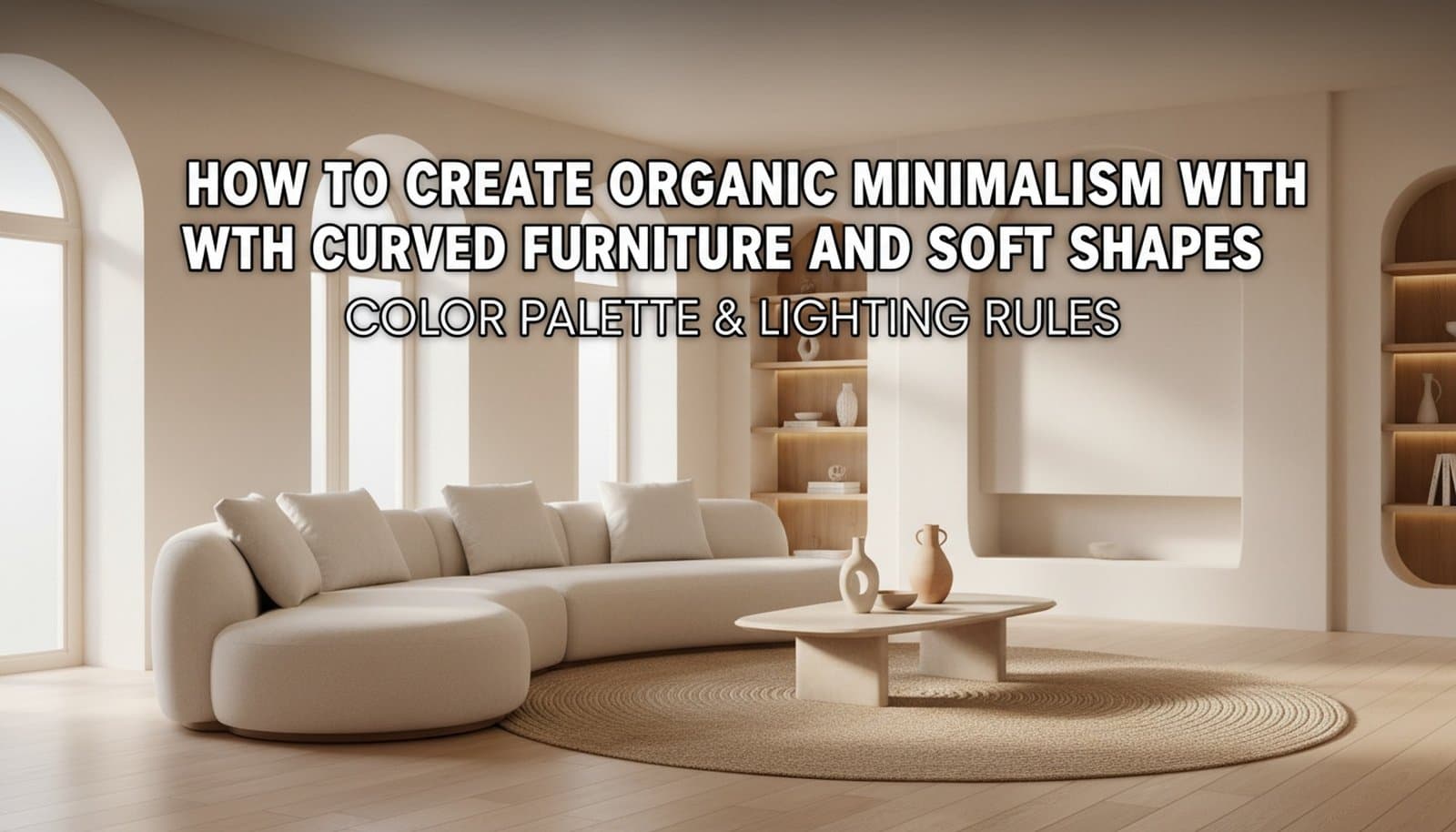
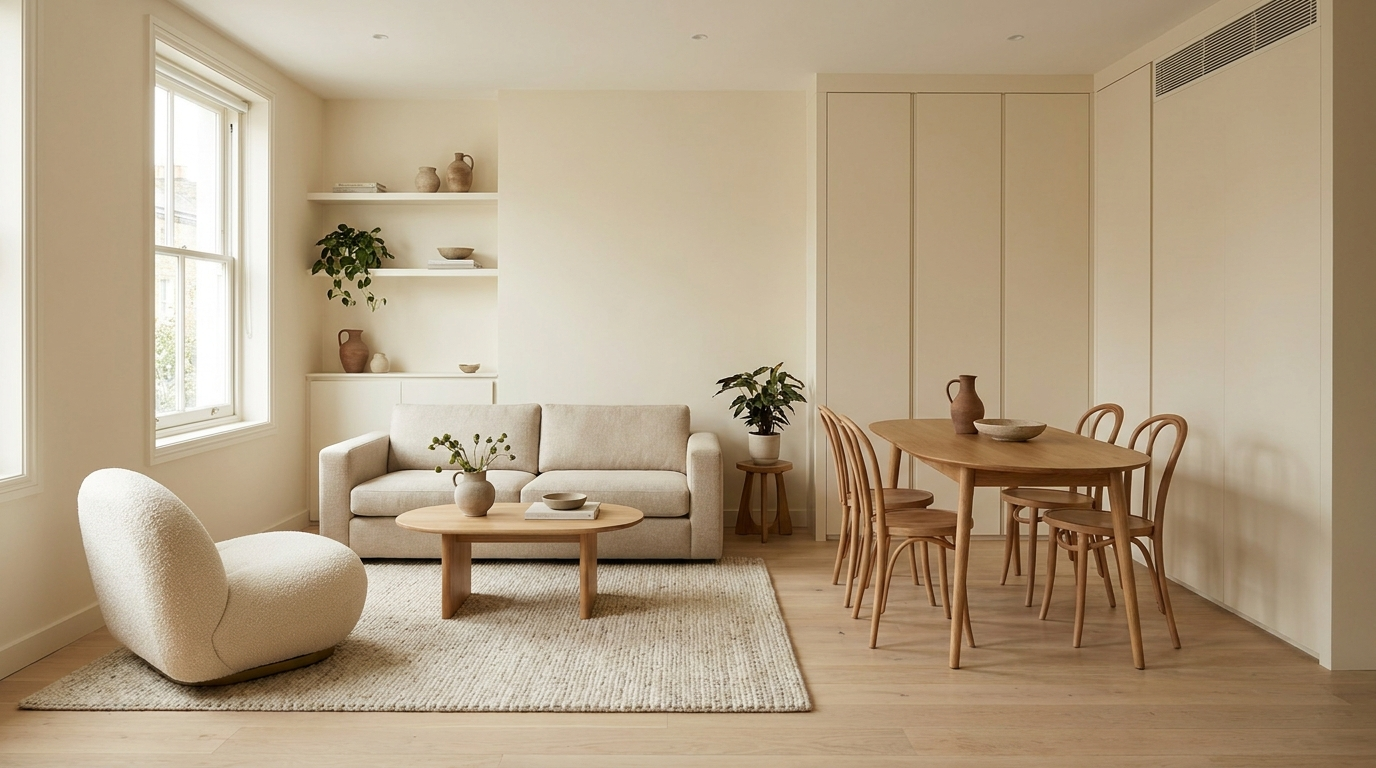
Organic minimalism combines a restrained room layout with natural-looking materials, warm color, tactile surfaces, and furniture that is simple without feeling severe. The room still has fewer visible objects than a conventionally decorated interior, but it does not depend on empty white space alone. Wood grain, linen, wool, stone, clay, and softly rounded forms supply the detail.
The easiest way to get the style wrong is to buy a collection of beige objects before solving the room. Start with function and storage, keep the pieces that already work, and build the palette from permanent surfaces such as flooring and cabinetry. Curved furniture comes later. One well-scaled curve can soften a rectangular room; a room full of rounded objects can look themed and leave awkward gaps.
An organic minimalist interior keeps the editing and functional clarity of minimalism, then replaces a cold or highly polished finish with warmer materials and softer shapes. The style is recognizable through restraint, not through a mandatory shopping list. A room may have a straight sofa and a curved table, or a curved sofa and a simple rectangular rug. What matters is that the forms have room around them and the materials do some of the visual work.
Natural does not have to mean rustic, handmade does not have to mean rough, and minimal does not have to mean empty. A flat-front oak cabinet, a tightly woven wool rug, and a matte ceramic lamp can all fit. So can a durable performance fabric that resembles linen when real linen would be impractical for the household. Material honesty includes being clear about what a product is and choosing it for the way the room is used.
Search results often use organic minimalism, organic modern, warm minimalism, and Japandi as if they were interchangeable. They overlap, but the emphasis changes. This distinction is useful when an inspiration board starts pulling in several directions.
| Style | Main Emphasis | Common Materials and Forms | Where It Can Drift |
|---|---|---|---|
| Organic Minimalism | Restraint softened by texture, natural references, and a few rounded forms | Wood, wool, linen, stone, clay, plaster, curved or softened silhouettes | Too much beige, impractical low furniture, or decor chosen only because it looks handmade |
| Organic Modern | Modern architecture and furniture balanced with warmer natural materials | Clean-lined upholstery, larger stone surfaces, wood, sculptural lighting | A luxury showroom look with little personal evidence |
| Warm Minimalism | Minimalist editing with warmer color and more comfortable textiles | Warm white, taupe, soft upholstery, pale or medium wood | A flat neutral scheme without enough grain or texture |
| Japandi | Japanese and Scandinavian design references, craft, function, and restraint | Low profiles, light and dark wood, woven materials, simple joinery | A generic imitation that treats distinct design traditions as a mood board |
If your priority is an even quieter room with stronger Japanese design references, the practical principles in our Zen interior design guide provide a more specific direction.
Before buying anything, photograph the room from the doorway and from the opposite corner. Then list what must stay, what is used every day, and what currently has no storage location. This separates a styling problem from a layout or storage problem. A room cannot remain visually quiet if chargers, toys, paperwork, blankets, and pet supplies have nowhere to go.
Mark the main walking route next. Large curved sofas often look inviting in wide editorial photographs, but their deepest point can project farther into the room than a straight sofa of similar width. Measure the complete footprint, including the curve, and tape it on the floor. Open nearby doors and drawers while the tape is down.
| Audit Question | What the Answer Changes |
|---|---|
| Which surfaces are permanent? | They determine the undertone and material direction for new paint, rugs, and furniture. |
| What must be within reach? | It determines where closed storage, side tables, task lights, and charging points belong. |
| Where do people walk? | It sets the real limit for sofa depth, chair angle, and coffee-table shape. |
| What creates the current visual noise? | It shows whether the room needs fewer objects, better storage, calmer color, or all three. |
| Which existing piece is worth designing around? | It gives the room a personal anchor and avoids replacing everything for the sake of a style label. |
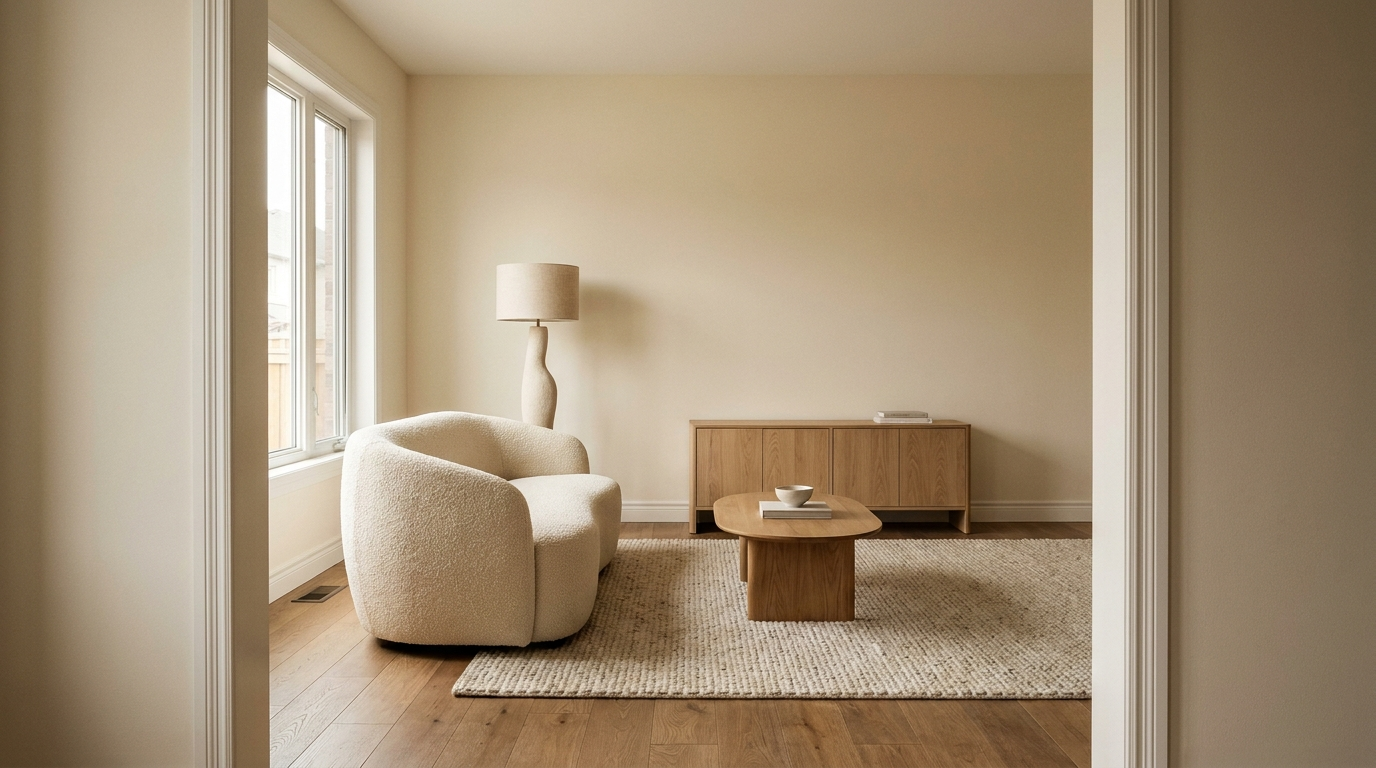
Clear the tops of consoles, side tables, and open shelving, but do not discard everything automatically. Return the objects you use or genuinely want to see. Group several small items on one tray or shelf rather than distributing them across the room. A useful lamp, a worn ceramic bowl, and a stack of books often give a room more character than a coordinated set bought to fill empty space.
Compare the floor, cabinets, stone, and largest piece of upholstery in daylight. If they lean yellow, red, gray, or green, bring that undertone into the wall color or repeat it in a nearby textile. This does not mean every surface must match. It means the largest colors should look intentional when seen together.
Pure white can make cream upholstery look dirty, while a very yellow white can exaggerate orange oak. Test several large paint samples beside the floor and sofa rather than choosing from a small chip held under store lighting.
When the palette is narrow, texture has to create separation. Pair a smooth wall with visible wood grain, a flat-weave rug with soft upholstery, or matte ceramic with a small glass element. Two surfaces that are close in color but different in texture can read as separate layers without adding a new accent color.
Natural fibers and stone are not automatically the right choice for every household. Jute can feel rough under bare feet, unsealed stone may stain, and loosely woven upholstery can catch pet claws. Choose the material after considering cleaning, sunlight, moisture, children, pets, and how often the surface is touched.
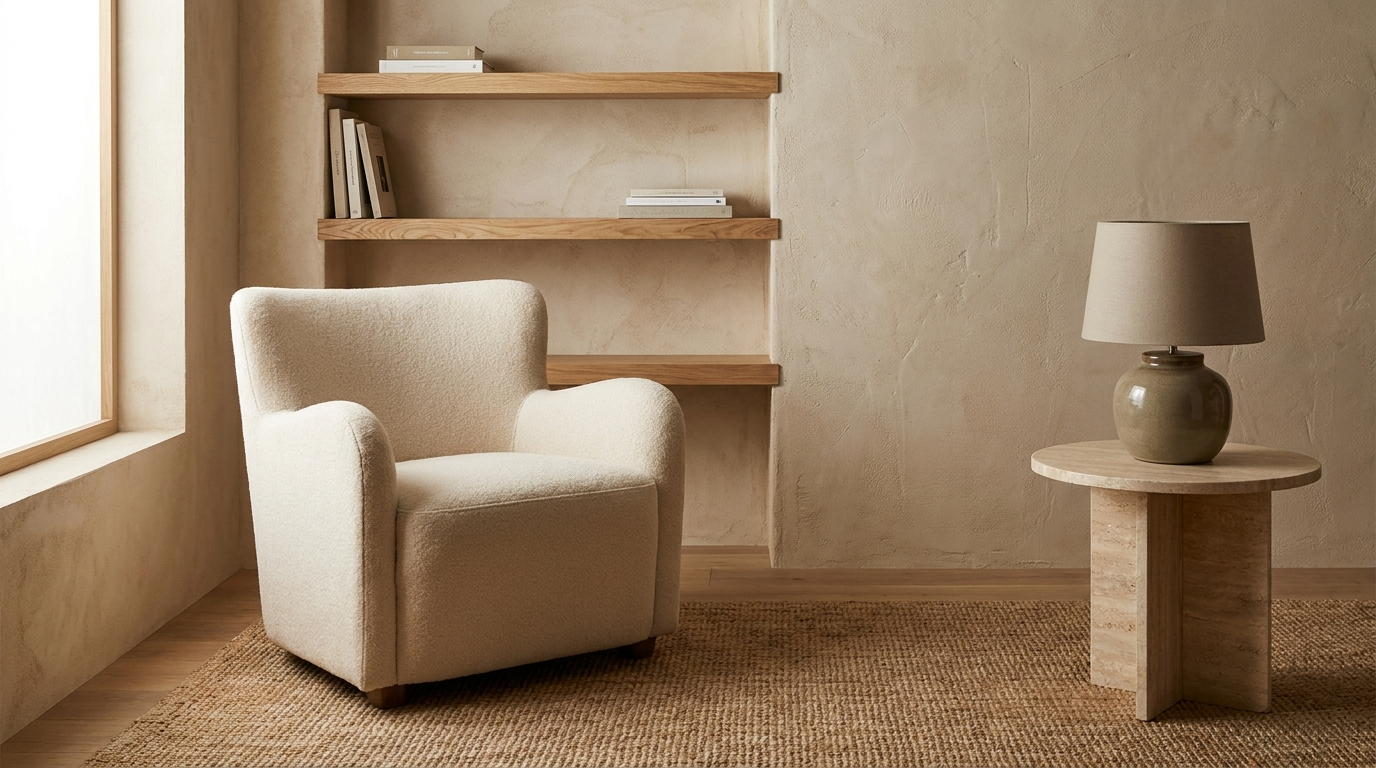
A curved sofa can redirect circulation around a seating area, but it also consumes floor space behind its arc. An oval coffee table removes sharp corners from a tight route. A round dining table can fit a square room better than a long rectangle. Choose the curve that helps the plan first, then judge its visual effect.
Curves need contrast. If the sofa, rug, coffee table, mirror, lamp, and doorway are all rounded, none of them has much impact. Keep some straight architecture and simple case goods in the composition. One large curve and one smaller echo are usually enough for a seating zone.
Low furniture appears often in organic minimalist interiors, but it is not comfortable or accessible for everyone. A sofa with slim arms, a visible base, and a normal seat height can have low visual weight without forcing the sitter close to the floor. Check seat height, seat depth, back support, and the effort required to stand before judging the silhouette.
Deep cloud-style sofas also require more than width measurements. Their loose cushions and rounded arms can make the usable seat smaller than the external dimensions suggest. Sit on the actual model when possible and measure the room using its full depth.
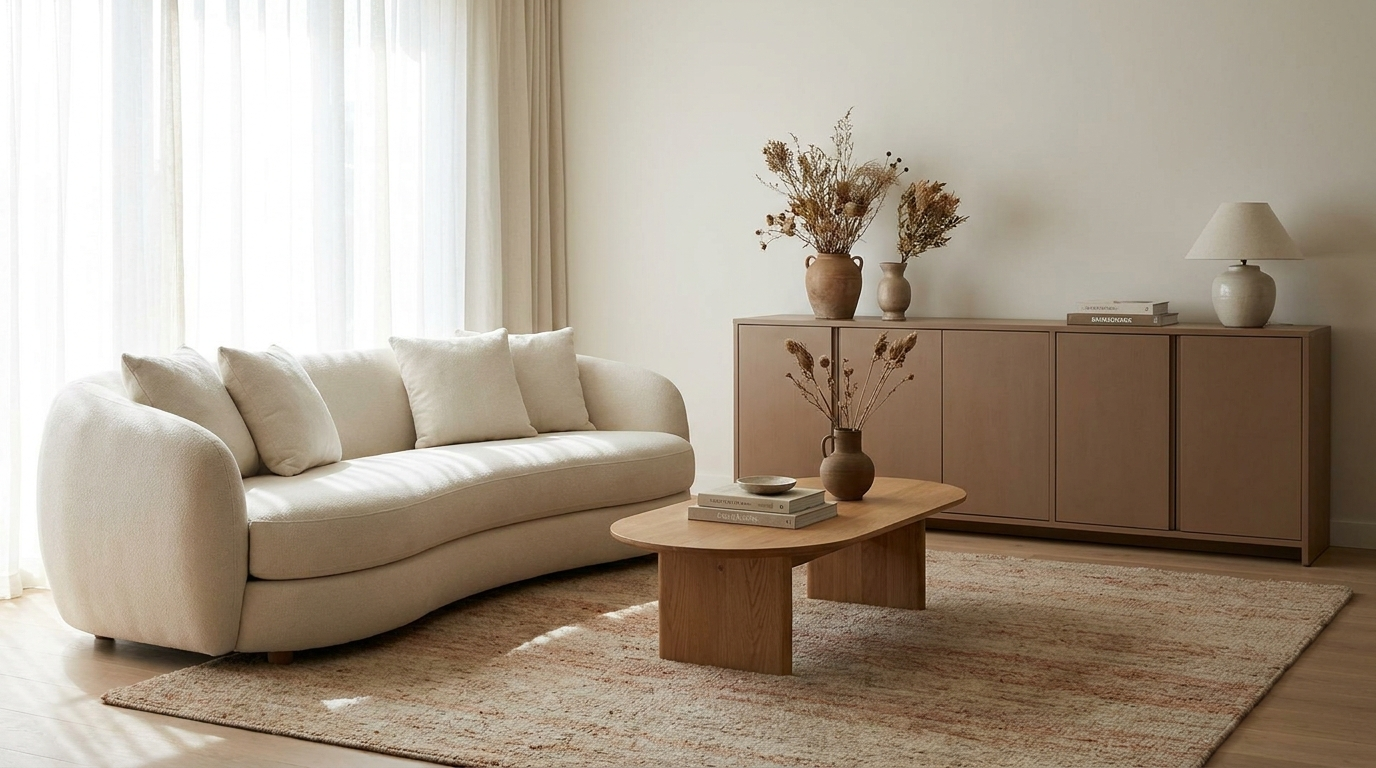
Open shelves work for books and a small number of objects. They are poor storage for cables, medicine, paperwork, cleaning supplies, toys, or spare bedding. Use drawers, full-height cabinets, storage benches, or boxes inside shelving for the less attractive parts of daily life. Match large storage fronts to the wall or nearby wood so they recede.
Do not hide function so thoroughly that the room becomes annoying to use. A remote can live in a drawer beside the sofa; it should not require crossing the room. Place storage where the item is used, then simplify the exterior.
Start with daylight and the tasks performed after dark. Add a reading lamp beside the chair, useful light near storage, and softer ambient light for the rest of the room. Ceramic, paper, linen, wood, and opal glass shades fit the style, but the shape of a fixture matters less than whether it puts light where someone needs it.
A single warm bulb cannot fix a flat room. Several pools of light reveal texture and depth more effectively than one bright ceiling source. Test the wall color and upholstery under the bulbs you actually use because warm artificial light can pull cream, clay, and wood toward yellow or orange.
Build the palette from three jobs: a light base, a material tone, and a grounding accent. The accent does not have to be paint. Dark wood, muted green upholstery, a clay-colored textile, or aged metal can provide enough weight.
| Palette Direction | Light Base | Material Tone | Grounding Accent | Works Well With |
|---|---|---|---|---|
| Warm and Airy | Warm ivory | Pale oak and oatmeal textile | Muted sage | Rooms with good daylight and light flooring |
| Earth and Clay | Soft plaster white | Terracotta and medium oak | Deep olive or brown | North-facing rooms that need visual warmth |
| Stone and Walnut | Warm greige | Travertine and walnut | Charcoal ceramic | Rooms with dark frames, hardware, or existing walnut |
| Soft Coastal | Chalk white | Bleached wood and flax | Dusty blue-gray | Bright rooms where a cooler accent is already present |
These are directions, not universal paint specifications. A color name changes between manufacturers, screens do not reproduce paint accurately, and the same finish can shift beside different flooring. Compare physical samples in the room before ordering a large quantity.
Keep the largest upholstered piece visually quiet, then let the coffee table, rug, lighting, and one chair supply variation. If the sofa is curved and deep, use a lighter table that can be moved easily. Closed storage along a straight wall gives the softer seating a useful counterpoint.
A bedroom does not need a low platform bed to qualify. Choose a bed height that is comfortable, then simplify the headboard and side tables. Linen-look bedding, wool, wood, and one plaster or ceramic lamp can carry the material story. Keep chargers and toiletries in drawers instead of styling every surface.
A round table is helpful in a square dining area or where people approach from several directions. In a narrow room, an oval or rectangular table usually uses the length better. Mix a simple table with chairs that have a curved back rather than forcing every component into a circular form.
Curved furniture needs stricter scale control in a small home. A compact chair, oval table, or rounded cabinet corner may deliver the effect more efficiently than a large crescent sofa. Choose furniture with visible floor beneath it, use one continuous wall color across connected spaces, and reserve visual weight for the piece the room actually needs.
The word natural does not prove that a product is responsibly sourced, durable, safe for a specific use, or easy to maintain. Ask what the material actually is, what finish protects it, how it should be cleaned, and whether parts can be repaired or replaced. Veneer can be a sensible use of timber. Engineered stone may be more practical than porous stone in a busy household. The honest choice is the one whose construction and limits are clear.
For wood and paper products, the Forest Stewardship Council explains how FSC certification and chain of custody work. A certification mark is more useful than vague phrases such as "eco-friendly wood," but it still does not replace checking the complete product, finish, transport, and expected lifespan.
An AI image can show whether a rounded sofa feels too dominant or whether a darker wood would balance pale walls. It cannot verify seat comfort, precise dimensions, fabric hand, stone porosity, paint color, or construction quality. Use the preview to narrow decisions, then verify them in the physical room.
A neutral palette is not a substitute for meaningful objects. Keep a piece of art, inherited table, book collection, or handmade object that belongs to the household. Give it enough space to be seen instead of replacing it with anonymous decor in the approved color range.
Rounded forms need straight lines around them. Choose the curve that helps the layout or deserves attention, then let walls, cabinets, or a rectangular rug stabilize the composition.
A loose cream boucle may be wrong for pets, sticky hands, or a sunny window. A rough rug may be unpleasant in a bedroom. Check care instructions, abrasion needs, light exposure, moisture, and how the surface feels before using it as a style signal.
Daily items do not disappear after a photo shoot. Plan closed storage near the activity it supports. The exterior can be visually quiet while the interior remains practical.
Plaster arches and built-in curved walls are expensive changes. You can create the same softer contrast with an oval table, a rounded chair, a paper pendant, or a large plant. Work with the existing architecture unless a renovation solves more than a styling problem.
Organic minimalism is a pared-back interior style that uses warm color, natural-looking materials, tactile surfaces, and softened furniture forms. It keeps visible possessions limited but does not aim for an empty or clinical room. Function, storage, material variation, and a few personal objects matter more than achieving a perfectly neutral photograph.
They overlap, and many rooms could reasonably carry either label. Organic modern usually begins with modern architecture or clean modern furniture and adds warmer materials. Organic minimalism puts more emphasis on editing, negative space, and fewer visible objects. The practical difference is small enough that function should decide the room, not the label.
No. Warm white, clay, sage, olive, dusty blue, walnut, charcoal, and muted terracotta can all work. Keep the largest surfaces related and use stronger color in a controlled area. The flooring and existing wood usually provide a better starting point than a generic beige palette.
Yes, but material choices need to reflect daily use. Favor washable covers, tighter weaves, durable rugs, rounded corners where useful, and closed storage near play or feeding areas. Avoid selecting delicate pale upholstery, porous stone, or rough fibers only because they look natural in a photograph.
No. Curved furniture is one way to soften a room, not a requirement. A round lamp, oval mirror, irregular ceramic, draped textile, or plant can introduce an organic line. In a narrow space, straight furniture may fit better and should take priority.
First check the wall and lighting undertones. Then add material contrast through wood grain, woven textile, wool, ceramic, or matte stone. Replace scattered small decor with one or two larger personal objects, and use closed storage to reduce visual noise without making the room difficult to live in.
Edit what is visible, solve storage, protect the walking route, and choose the largest necessary furniture. Only then add color, texture, lighting, and a curved form where it earns the floor space. Organic minimalism works best when the room feels easier to use, not merely easier to photograph.