6 min. reading

Yulii Cherevko
CEO paintit.ai

In traditional e-commerce, the shopper does the work: searches, opens product pages, compares options, reads policies, and completes checkout. In agentic commerce, an AI agent can do some of that work against a shopper's stated constraints, then present or sometimes execute the next step with permission. The useful distinction is not “AI versus a website.” It is who carries the comparison and transaction work, and how much control the shopper delegates.
For retailers, that changes the job of a product page. It still has to persuade a person, but its price, availability, dimensions, delivery promise, returns policy, and product identity also need to be clear enough for another system to interpret without guessing. Agentic commerce is not a reason to abandon the store. It is a reason to make the information behind the store more dependable.
Both models still need a reliable catalog, payment processing, fulfillment, support, and a clear return policy. The difference is where the shopper's intent is interpreted and who turns it into a shortlist or an order.
| Part of the Journey | Traditional E-Commerce | Agentic Commerce |
|---|---|---|
| Starting point | The shopper opens a store, marketplace, or search result. | The shopper describes an outcome, constraints, and preferences to an agent. |
| Discovery | The shopper searches, filters, and opens product pages. | The agent retrieves candidates from available product data and explains the shortlist. |
| Comparison | The shopper reconciles price, reviews, fit, delivery, and policy details across tabs. | The agent can compare those constraints in one flow, provided the source data is current and specific. |
| Checkout | The shopper enters or confirms details in the store's checkout. | The agent may prepare or initiate checkout within an authorized flow; the merchant still accepts the order and fulfills it. |
| Merchandising | Images, navigation, category pages, and promotion influence what the shopper notices. | Structured attributes, availability, policy clarity, and relevance influence whether an item reaches the shortlist. |
| Main failure mode | Too much browsing, weak filters, or unclear product pages. | A convincing answer based on stale, incomplete, or incorrectly matched product information. |
Current implementations are often supervised rather than fully autonomous. In OpenAI's Instant Checkout flow, the shopper confirms order, shipping, and payment details, while the merchant continues to handle orders, payments, fulfillment, and support through its own systems.
A shopper still wants to inspect a product, understand the brand, check photos, ask a question, and sometimes browse without a fixed plan. That is especially true for expensive, aesthetic, or personal purchases. A conversational shortlist does not replace the role of a useful product page; it makes each product page's underlying facts easier to reuse elsewhere.
Think of agentic commerce as an additional route into the store rather than a replacement for the storefront. A person may start with an AI assistant, a search engine, a marketplace, social content, or the retailer's own site. The retailer needs a consistent answer whichever route produced the question.
“Agent” is often used too loosely. A recommendation widget that shows related products is not necessarily an agent. A chat interface that only restates a product description is not necessarily an agent either. The useful threshold is whether the system can use a goal and defined constraints to select tools or product data, compare options, and carry a bounded task forward.
For a request such as “find a washable sectional under $2,000 that fits a narrow living room and can arrive next week,” an agentic flow might check catalog attributes, stock, dimensions, shipping estimates, and return conditions before showing options. It should not invent missing measurements, promise a delivery date it cannot verify, or decide that a sofa will fit without enough room information.
Before an agent can compare products or prepare checkout, it needs structured access to inventory, prices, and checkout logic instead of relying on brittle page scraping, as Stripe explains in its guide to agentic commerce.
Furniture exposes the weak spots in generic shopping automation. A product can be in stock and still be a poor recommendation because it will not fit the room, does not work with the desired layout, or looks wrong next to what the customer already owns. Before an agent presents a room solution, use this three-part test.
| Test | Questions to Answer | What Can Go Wrong |
|---|---|---|
| Sellability | Is the exact SKU available in the shopper's market, at the stated price, with a known delivery and return policy? | The agent recommends a discontinued variant, a regional mismatch, or an expired price. |
| Physical Fit | Do dimensions, clearance, door access, assembly requirements, and room measurements support the recommendation? | A visually appealing item blocks a path, cannot enter the room, or leaves no usable clearance. |
| Visual Fit | Does the color, scale, material, and style work with the actual room and the shopper's stated preference? | The item is technically purchasable but creates a result the shopper immediately rejects. |
This is a practical operating test, not a claim that an AI system can certify a room. The first check comes from commerce data. The second needs reliable measurements and may need human confirmation. The third benefits from visual comparison before purchase.
For the broader furniture-retail use case, see our guide to Agentic AI in Furniture E-Commerce. Keep that link as supporting context, not as a substitute for verified SKU and fulfillment data.
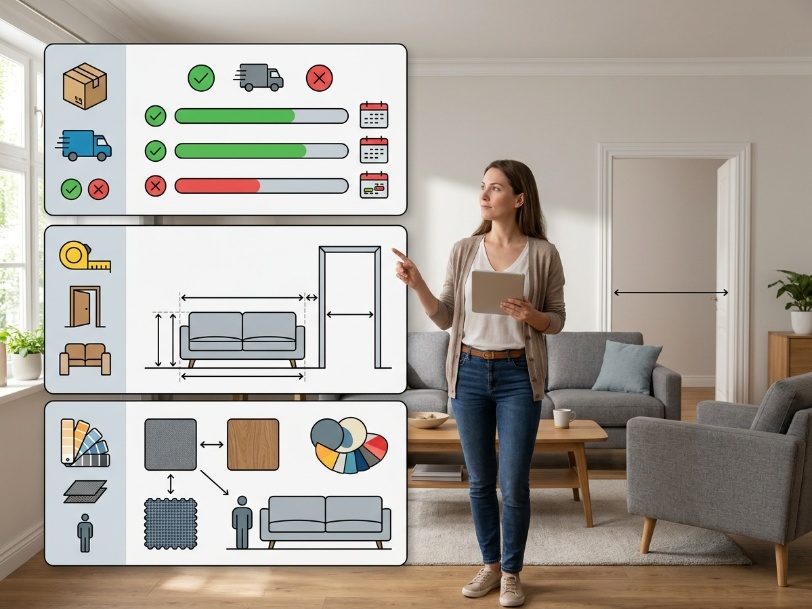
The second flow may be faster, but only if the facts are dependable. An agent can compress decision work; it cannot repair weak catalog data or rescue an unrealistic delivery promise.
Agentic commerce changes where a customer may begin, not who is responsible for the order. The retailer still controls the sellable catalog, pricing rules, order acceptance, taxes, fulfillment, returns, customer service, and brand commitments. That is the operational center of the transaction.
What becomes less predictable is the discovery layer. A shopper may never use a category page, yet still arrive at a product through an assistant's comparison. This makes vague attributes costly. “Comfortable,” “premium,” or “small” are marketing language; a machine and a shopper both need dimensions, material details, care instructions, compatibility, availability, and policy terms that can be checked.
For furnishings, a room image can answer a question that a product card cannot: does this direction feel right in the actual space? Use AI Virtual Staging to compare a furnishing direction in a property or room photo before the shopper commits to the shortlist. The result is a visual discussion aid, not proof of exact dimensions, inventory, construction requirements, or final product availability.

Traditional e-commerce asks the shopper to navigate the buying process. Agentic commerce allows an AI agent to carry out defined parts of discovery, comparison, and sometimes checkout on the shopper's behalf. The shopper can still review or approve the result, and the merchant still handles the actual order obligations.
No. Permission depends on the product, platform, payment method, and merchant flow. A responsible setup defines what the agent may do, what requires confirmation, and what must be handed to a person. Treat autonomy as a set of bounded permissions, not a single on-or-off switch.
At minimum, the data used for a recommendation must identify the exact sellable product and its current price, availability, core attributes, delivery terms, and return policy. High-consideration categories need more: dimensions, compatibility, installation or assembly requirements, and material or care information.
No. A website remains the place where customers inspect products, discover the brand, seek support, and complete purchases when they prefer a familiar storefront. Agentic channels add another entry point. The strongest retailers make their core product and policy information consistent across both.
Start with one narrow, observable problem. A curated product comparison, a room-planning assistant, or a reliable order-status flow is easier to evaluate than an open-ended buying agent. Keep the approval step visible, record errors, and improve the catalog data that caused them.
Agentic commerce vs. traditional e-commerce is not a contest with one winner. Traditional storefronts remain valuable because people still want to look, question, and choose. Agentic flows are useful when they reduce repetitive comparison work without hiding the assumptions behind a recommendation.
The sensible first move is not to promise autonomous shopping. Make the catalog truthful, make fulfillment and policy details visible, and give customers a clear chance to approve expensive or consequential decisions. Once that foundation exists, an agent has something solid to work with.