We use essential cookies to make our site work. With your consent, we may also use non-essential cookies to improve user experience, personalize content, and analyze website traffic. For these reasons, we may share your site usage data with our social media and analytics partners. By clicking “Accept,“ you agree to our website's cookie use as described in our Cookie Policy. You can change your cookie settings at any time on your browser preferences.
  • À propos
  • Tarifs
  • Blog
  • Contact
AiEi

Produits

  • Pour les architectes d’intérieur
  • Pour l’e-commerce
  • Pour l’immobilier

Outils

Générateur d’architecture par IA
Générateur de concepts par IA
Aménagement extérieur par IA
Générateur de maisons par IA
Simulation de peinture de maison par IA
Aménagement paysager par IA
Rendu par IA
Aménagement de pièces par IA
Outil d’aménagement extérieur de maison
Home staging virtuel par IA
Rénovation de salle de bains par IA
Générateur de plans par IA
Générateur de meubles par IA
Disposition des meubles par IA
Rénovation extérieure de maison
Simulateur de couleurs de peinture par IA
Rénovation de cuisine par IA
Simulateur de tapis par IA
Amélioration de photos immobilières
Rendu de décoration intérieure par IA
Décoration murale par IA
Conception de portes par IA
Rendu de plans par IA
Conception de sols par IA
Outil de conception d’allées carrossables
Outil de conception de pavages
Plans d’extension de maison
Du croquis au rendu par IA
Du plan de façade au rendu
Conception de placards par IA
Conception de terrasses par IA
Planificateur de jardin par IA
Rénovation et décoration intérieure par IA
Simulateur de fenêtres par IA
Simulateur de peinture pour meubles
Simulateur de plans de travail de cuisine
Outil de conception d’éclairage paysager
Simulateur de rideaux par IA
Amélioration de rendus par IA

Cas d’usage

Aménagement de cuisine par IA
Aménagement de salon par IA
Aménagement de chambre par IA
Aménagement de salle de bains par IA
Aménagement paysager par IA
Aménagement de dressing par IA
Aménagement de bureau par IA
Conception de piscine par IA
Aménagement de buanderie par IA
Aménagement de restaurant par IA
Aménagement de salle de classe par IA
Aménagement de sous-sol par IA
  • Conditions d’utilisation
  • Politique de confidentialité
  • Confiance
  • Programme d’affiliation
Logo
Paintit.ai - Outil gratuit de décoration intérieure par IA

© 2026

Soutenez l’Ukraine
PAINTITAI LTD, 52 Leytonstone road, London, E15 1SQ, UK
  • English/
  • Español/
  • Português (Brasil)/
  • Deutsch/
  • Français
Paintit.ai - décoration intérieure gratuite par IA
  • Tarifs
  • À propos
  • Blog
  • Contact
/Blog/Agentic Shift Why e Commerce is About to Chan
AI technologies

6 min. reading

Agentic Commerce vs. Traditional E-Commerce: What Actually Changes? 

avatar-blog

Yulii Cherevko

CEO paintit.ai

Published: 7 November 2025

Share
  • ChatGPT
  • Perplexity
  • Claude
  • Grok
  • Google AI
Agentic Commerce vs. Traditional E-Commerce: What Actually Changes?

Page 
Contents: 

  • 1. Key Takeaways
  • 2. Agentic Commerce vs. Traditional E-Commerce at a Glance
  • 3. Traditional E-Commerce Is Not Going Away
  • 4. What an Agent Actually Does
  • 5. The Furniture and Home-Goods Test: Three Facts Must Agree
  • 6. One Purchase Journey, Two Different Flows
  • 7. What Retailers Still Control
  • 8. What to Fix Before Adding an Agent
  • 9. Where Visual Planning Fits
  • 10. Frequently Asked Questions
  • 11. Make the Store Easier to Trust and Easier to Interpret

In traditional e-commerce, the shopper does the work: searches, opens product pages, compares options, reads policies, and completes checkout. In agentic commerce, an AI agent can do some of that work against a shopper's stated constraints, then present or sometimes execute the next step with permission. The useful distinction is not “AI versus a website.” It is who carries the comparison and transaction work, and how much control the shopper delegates.

For retailers, that changes the job of a product page. It still has to persuade a person, but its price, availability, dimensions, delivery promise, returns policy, and product identity also need to be clear enough for another system to interpret without guessing. Agentic commerce is not a reason to abandon the store. It is a reason to make the information behind the store more dependable.

Key Takeaways

  • Traditional e-commerce is a shopper-led flow; agentic commerce delegates parts of discovery, comparison, and checkout to an AI agent.
  • The biggest change is the path to the shortlist. A shopper may see three options instead of forty product pages.
  • Accurate product data, current inventory, delivery terms, and return rules become more important when an agent is evaluating a catalog.
  • Agentic commerce does not remove the retailer's responsibilities for pricing, fulfillment, customer service, refunds, or consent.
  • For furniture and home goods, an order should pass a sellability, physical-fit, and visual-fit check before it is recommended as a complete solution.

Agentic Commerce vs. Traditional E-Commerce at a Glance

Both models still need a reliable catalog, payment processing, fulfillment, support, and a clear return policy. The difference is where the shopper's intent is interpreted and who turns it into a shortlist or an order.

Part of the Journey Traditional E-Commerce Agentic Commerce
Starting point The shopper opens a store, marketplace, or search result. The shopper describes an outcome, constraints, and preferences to an agent.
Discovery The shopper searches, filters, and opens product pages. The agent retrieves candidates from available product data and explains the shortlist.
Comparison The shopper reconciles price, reviews, fit, delivery, and policy details across tabs. The agent can compare those constraints in one flow, provided the source data is current and specific.
Checkout The shopper enters or confirms details in the store's checkout. The agent may prepare or initiate checkout within an authorized flow; the merchant still accepts the order and fulfills it.
Merchandising Images, navigation, category pages, and promotion influence what the shopper notices. Structured attributes, availability, policy clarity, and relevance influence whether an item reaches the shortlist.
Main failure mode Too much browsing, weak filters, or unclear product pages. A convincing answer based on stale, incomplete, or incorrectly matched product information.

Current implementations are often supervised rather than fully autonomous. In OpenAI's Instant Checkout flow, the shopper confirms order, shipping, and payment details, while the merchant continues to handle orders, payments, fulfillment, and support through its own systems.

Traditional E-Commerce Is Not Going Away

A shopper still wants to inspect a product, understand the brand, check photos, ask a question, and sometimes browse without a fixed plan. That is especially true for expensive, aesthetic, or personal purchases. A conversational shortlist does not replace the role of a useful product page; it makes each product page's underlying facts easier to reuse elsewhere.

Think of agentic commerce as an additional route into the store rather than a replacement for the storefront. A person may start with an AI assistant, a search engine, a marketplace, social content, or the retailer's own site. The retailer needs a consistent answer whichever route produced the question.

What an Agent Actually Does

“Agent” is often used too loosely. A recommendation widget that shows related products is not necessarily an agent. A chat interface that only restates a product description is not necessarily an agent either. The useful threshold is whether the system can use a goal and defined constraints to select tools or product data, compare options, and carry a bounded task forward.

For a request such as “find a washable sectional under $2,000 that fits a narrow living room and can arrive next week,” an agentic flow might check catalog attributes, stock, dimensions, shipping estimates, and return conditions before showing options. It should not invent missing measurements, promise a delivery date it cannot verify, or decide that a sofa will fit without enough room information.

Before an agent can compare products or prepare checkout, it needs structured access to inventory, prices, and checkout logic instead of relying on brittle page scraping, as Stripe explains in its guide to agentic commerce.

The Furniture and Home-Goods Test: Three Facts Must Agree

Furniture exposes the weak spots in generic shopping automation. A product can be in stock and still be a poor recommendation because it will not fit the room, does not work with the desired layout, or looks wrong next to what the customer already owns. Before an agent presents a room solution, use this three-part test.

Test Questions to Answer What Can Go Wrong
Sellability Is the exact SKU available in the shopper's market, at the stated price, with a known delivery and return policy? The agent recommends a discontinued variant, a regional mismatch, or an expired price.
Physical Fit Do dimensions, clearance, door access, assembly requirements, and room measurements support the recommendation? A visually appealing item blocks a path, cannot enter the room, or leaves no usable clearance.
Visual Fit Does the color, scale, material, and style work with the actual room and the shopper's stated preference? The item is technically purchasable but creates a result the shopper immediately rejects.

This is a practical operating test, not a claim that an AI system can certify a room. The first check comes from commerce data. The second needs reliable measurements and may need human confirmation. The third benefits from visual comparison before purchase.

For the broader furniture-retail use case, see our guide to Agentic AI in Furniture E-Commerce. Keep that link as supporting context, not as a substitute for verified SKU and fulfillment data.
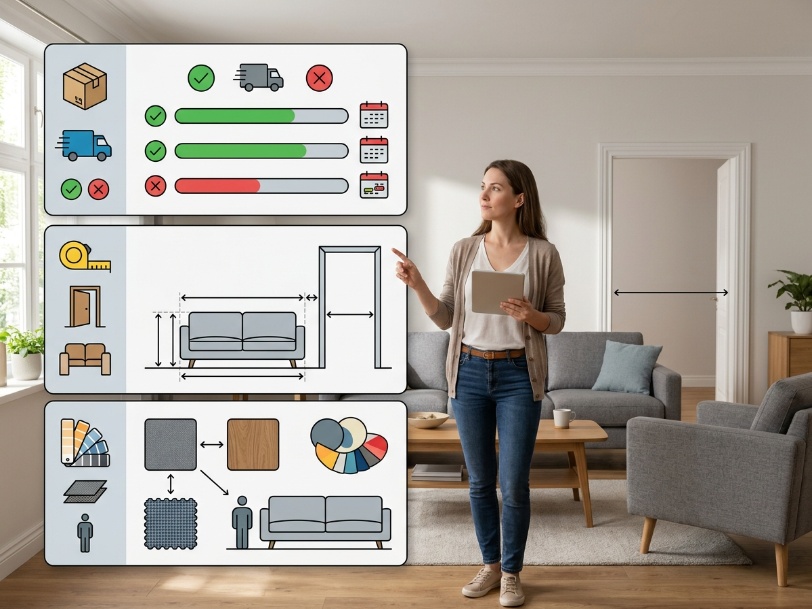
Shopper checking product availability, sofa clearance, and visual fit before buying furniture online

One Purchase Journey, Two Different Flows

Traditional E-Commerce Flow

  1. The shopper searches for a sofa, opens several retailers, and filters by price and color.
  2. They compare dimensions in separate tabs, estimate fit from photos, and look for delivery and return information.
  3. They build a cart, ask a household member for an opinion, and either buy or leave to think about it.

Agentic Commerce Flow

  1. The shopper supplies a goal: a sectional for a 10-foot wall, a budget ceiling, a preferred fabric, a pet constraint, and a delivery deadline.
  2. The agent turns those inputs into filters, checks available information, and returns a short explanation of why each candidate fits the brief.
  3. The shopper reviews the options, asks for a change, and confirms the order only when the merchant's checkout flow has the required information.

The second flow may be faster, but only if the facts are dependable. An agent can compress decision work; it cannot repair weak catalog data or rescue an unrealistic delivery promise.

What Retailers Still Control

Agentic commerce changes where a customer may begin, not who is responsible for the order. The retailer still controls the sellable catalog, pricing rules, order acceptance, taxes, fulfillment, returns, customer service, and brand commitments. That is the operational center of the transaction.

What becomes less predictable is the discovery layer. A shopper may never use a category page, yet still arrive at a product through an assistant's comparison. This makes vague attributes costly. “Comfortable,” “premium,” or “small” are marketing language; a machine and a shopper both need dimensions, material details, care instructions, compatibility, availability, and policy terms that can be checked.

What to Fix Before Adding an Agent

  1. Resolve product identity. Give every sellable variant a stable SKU and keep price, availability, dimensions, and delivery coverage attached to that exact variant.
  2. Write policies in usable language. Returns, lead times, assembly, warranty, and exclusions should be specific enough to answer a customer's question without interpretation.
  3. Set permission boundaries. Decide which actions an assistant may take, where a human must confirm, and when an exception goes to customer support.
  4. Measure bad recommendations. Track not only conversion, but unavailable-product suggestions, cancellation reasons, return reasons, and cases where the shopper corrects the agent.
  5. Test a narrow job first. Start with a constrained task such as product comparison, order-status help, or visual room planning. Do not ask a new system to run pricing, customer data, and checkout policy all at once.

Where Visual Planning Fits

For furnishings, a room image can answer a question that a product card cannot: does this direction feel right in the actual space? Use AI Virtual Staging to compare a furnishing direction in a property or room photo before the shopper commits to the shortlist. The result is a visual discussion aid, not proof of exact dimensions, inventory, construction requirements, or final product availability.

Empty living room compared with a visually staged furniture layout showing sofa scale and clear circulation.

Frequently Asked Questions

What Is the Main Difference Between Agentic Commerce and Traditional E-Commerce?

Traditional e-commerce asks the shopper to navigate the buying process. Agentic commerce allows an AI agent to carry out defined parts of discovery, comparison, and sometimes checkout on the shopper's behalf. The shopper can still review or approve the result, and the merchant still handles the actual order obligations.

Does Agentic Commerce Mean an AI Can Buy Anything Without Permission?

No. Permission depends on the product, platform, payment method, and merchant flow. A responsible setup defines what the agent may do, what requires confirmation, and what must be handed to a person. Treat autonomy as a set of bounded permissions, not a single on-or-off switch.

What Data Does a Retailer Need for Agentic Commerce?

At minimum, the data used for a recommendation must identify the exact sellable product and its current price, availability, core attributes, delivery terms, and return policy. High-consideration categories need more: dimensions, compatibility, installation or assembly requirements, and material or care information.

Will Agentic Commerce Replace a Retailer's Website?

No. A website remains the place where customers inspect products, discover the brand, seek support, and complete purchases when they prefer a familiar storefront. Agentic channels add another entry point. The strongest retailers make their core product and policy information consistent across both.

Where Should a Furniture Retailer Start?

Start with one narrow, observable problem. A curated product comparison, a room-planning assistant, or a reliable order-status flow is easier to evaluate than an open-ended buying agent. Keep the approval step visible, record errors, and improve the catalog data that caused them.

Make the Store Easier to Trust and Easier to Interpret

Agentic commerce vs. traditional e-commerce is not a contest with one winner. Traditional storefronts remain valuable because people still want to look, question, and choose. Agentic flows are useful when they reduce repetitive comparison work without hiding the assumptions behind a recommendation.

The sensible first move is not to promise autonomous shopping. Make the catalog truthful, make fulfillment and policy details visible, and give customers a clear chance to approve expensive or consequential decisions. Once that foundation exists, an agent has something solid to work with.


Trending 

Paintit.ai Guides
13 min read
Interior Design Questionnaire: Free Template and Example
interior styles
11 min read
Japandi Interior Design: A Practical Guide for Real Homes
Ideas
11 min read
7 Warm White Paint Colors for Walls and Trim
Paintit.ai Guides
6 min read
Lighting Scene Planning: A Practical Worksheet
ai wall paint
6 min read
Paint Color Placement: A Study of 60 Requests

Related articles 

Interior Design Proposal Template: Scope, Fees and Example
Paintit.ai Guides
9 november 2026

11 min read

Interior Design Proposal Template: Scope, Fees and Example

A fillable proposal worksheet and a worked home-office example, with defined deliverables, fees, revision limits and clearly labeled visual concepts.

avatar-blog

Yulii Cherevko

CEO paintit.ai

Interior Design Questionnaire: Free Template and Example
Paintit.ai Guides
9 november 2026

13 min read

Interior Design Questionnaire: Free Template and Example

A 32-question client template with a fillable PDF, a completed living-room example and a clear route from client answers to an early design brief.

avatar-blog

Yulii Cherevko

CEO paintit.ai

Japandi Interior Design: A Practical Guide for Real Homes
interior stylesIdeas
30 october 2026

11 min read

Japandi Interior Design: A Practical Guide for Real Homes

Bring Japanese and Scandinavian influences into a home you already live in, with practical choices for color, furniture, storage and everyday comfort.

avatar-blog

Yulii Cherevko

CEO paintit.ai

7 Warm White Paint Colors for Walls and Trim
Ideas
29 october 2026

11 min read

7 Warm White Paint Colors for Walls and Trim

Find a warm white that works with your floor, cabinets and trim. Compare seven named shades and learn which samples to test before buying paint.

avatar-blog

Yulii Cherevko

CEO paintit.ai

Lighting Scene Planning: A Practical Worksheet
Paintit.ai Guidesai room design
28 october 2026

6 min read

Lighting Scene Planning: A Practical Worksheet

Compare living room lighting scenes with a source-by-source worksheet. Separate fixture changes from on/off states and keep daylight and finishes fixed.

avatar-blog

Yulii Cherevko

CEO paintit.ai

Paint Color Placement: A Study of 60 Requests
ai wall paintai house painter
24 october 2026

6 min read

Paint Color Placement: A Study of 60 Requests

A study of 60 Paintit requests separates color choice from painted areas. See the findings, boundary diagrams and a practical paint placement worksheet.

avatar-blog

Yulii Cherevko

CEO paintit.ai

  • English/
  • Español/
  • Português (Brasil)/
  • Deutsch/
  • Français