7 min. reading

Yulii Cherevko
CEO paintit.ai
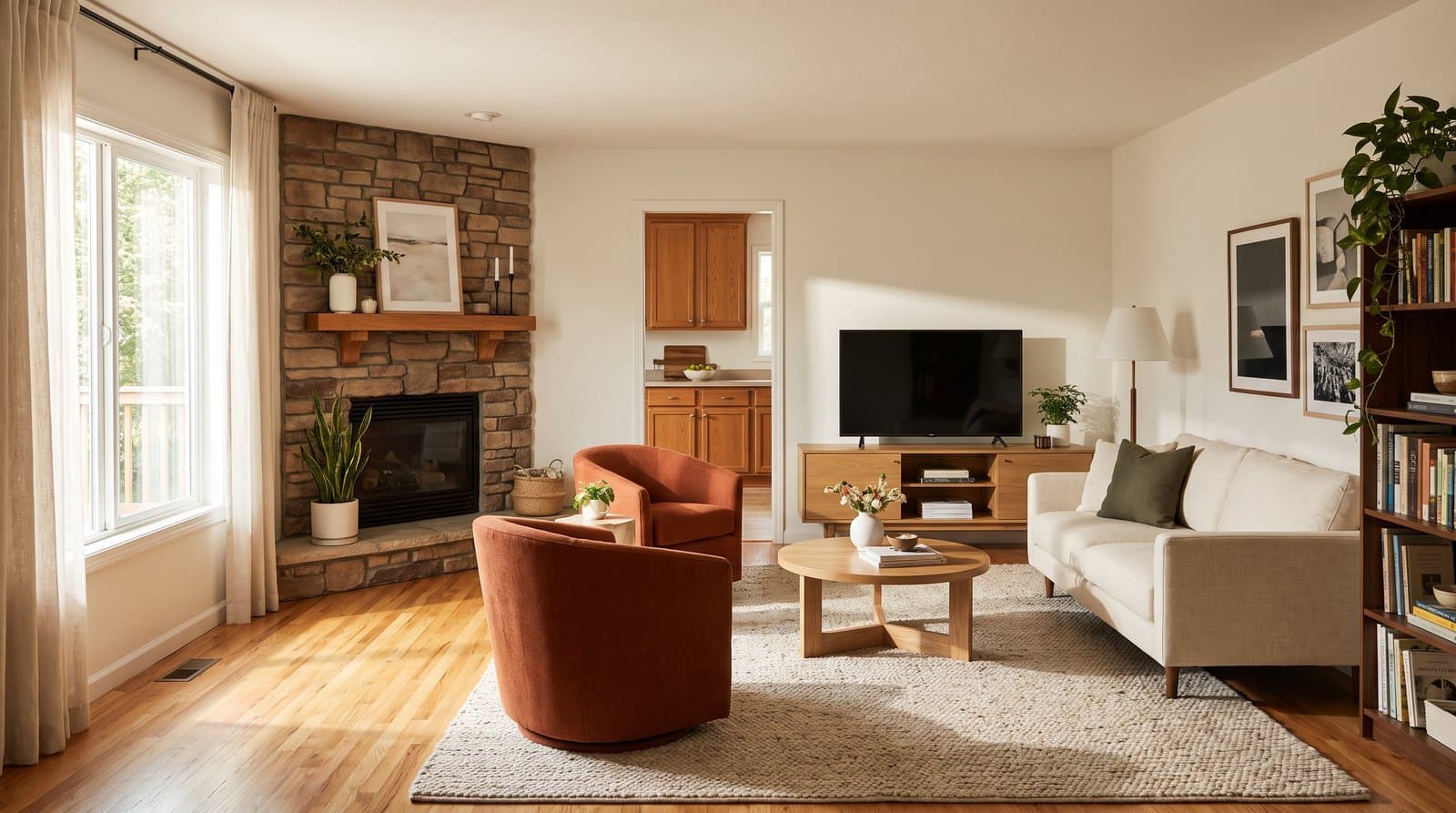
An awkward living room does not need a clever decor trick. It needs a layout that decides three things in the right order: where people walk, what the room faces, and which furniture deserves the limited floor space. Start by protecting the route between doors, then place the largest seating piece, then resolve the fireplace and TV. Everything else is secondary.
This guide focuses on the situations generic furniture-arrangement advice tends to skip: a fireplace that is not centered, a TV competing with the fireplace, a corner fireplace, a long narrow room, and walls broken up by doors or windows. Each solution includes a simple test you can run before buying or moving anything.
Measure only what changes the decision. Mark every doorway and its swing, the fireplace footprint, windows, radiators, permanent built-ins, and the wall where a TV could realistically live. Then draw one line for the route people actually take from the main entry to the next room. That route is not leftover space. It is the part of the plan that the sofa, coffee table, and accent chairs cannot steal.
Next, label the room's non-negotiables. A fireplace may need a visible hearth. A door may need its full swing. A window may be the only daylight source. An awkward layout becomes easier once you stop treating every wall as equally available.
| Mark This First | What It Prevents | Useful Question |
|---|---|---|
| Primary walking route | A sofa or chair that makes people squeeze around the seating area. | Can someone reach the next room without cutting through the conversation zone? |
| Fixed focal point | Buying furniture before deciding whether the fireplace, TV, or view leads the room. | Where do people naturally look when they sit down? |
| Usable walls | Planning a media unit or sectional on a wall interrupted by a door, radiator, or opening. | Which wall can carry the largest piece without blocking daily life? |
| Furniture depth | A plan that works on paper but leaves no sensible route around the sofa or chairs. | What remains after the deepest piece is placed? |
Do not begin with "How can I make this room look better?" That question invites a pretty but unusable answer. Pick the conflict that is causing trouble: the TV is too far from the sofa, the fireplace sits in a corner, a door slices through the best wall, or the room reads as a corridor. One room can have several issues, but one should lead the first layout test.
| If the Room Has... | Start With... | Avoid... |
|---|---|---|
| Off-center fireplace | A conversation group that acknowledges the fireplace without forcing mirror-image furniture. | Making every piece line up to the room's geometric center. |
| Corner fireplace | A floating sofa or two chairs angled toward the corner. | Placing a sectional so close that the fireplace becomes visually trapped. |
| Fireplace and TV on different walls | A seating plan that favors the activity you do most often. | Pretending both walls can be the room's equally dominant center. |
| Long, narrow proportions | Two compact zones across the room's length. | A sofa, console, and chairs all pressed into one continuous line. |
| Several doors or openings | A furniture island with routes around it. | Using the walls as storage for every large piece. |
An off-center fireplace does not require matching chairs, matching tables, and a sofa centered to the firebox. Instead, center the seating group on the useful part of the room. The fireplace can be one side of that group, supported by a tall plant, bookcase, art, or lighting on the wider side. The goal is visual balance, not architectural symmetry.
Begin with the sofa. If the fireplace is on the longest workable wall, place the sofa facing it and use one or two movable chairs to complete the group. If the fireplace is near a doorway, keep the main sofa on the opposing usable wall and let the chairs turn toward the hearth. A round or oval coffee table often keeps the route softer than a wide rectangular table when people need to pass at an angle.
Layout test: Tape the sofa footprint on the floor, then place dining chairs where future lounge chairs would sit. Walk from each door to the next room. If the fireplace reads clearly and nobody has to cut between a chair and the hearth, the layout is worth visualizing.
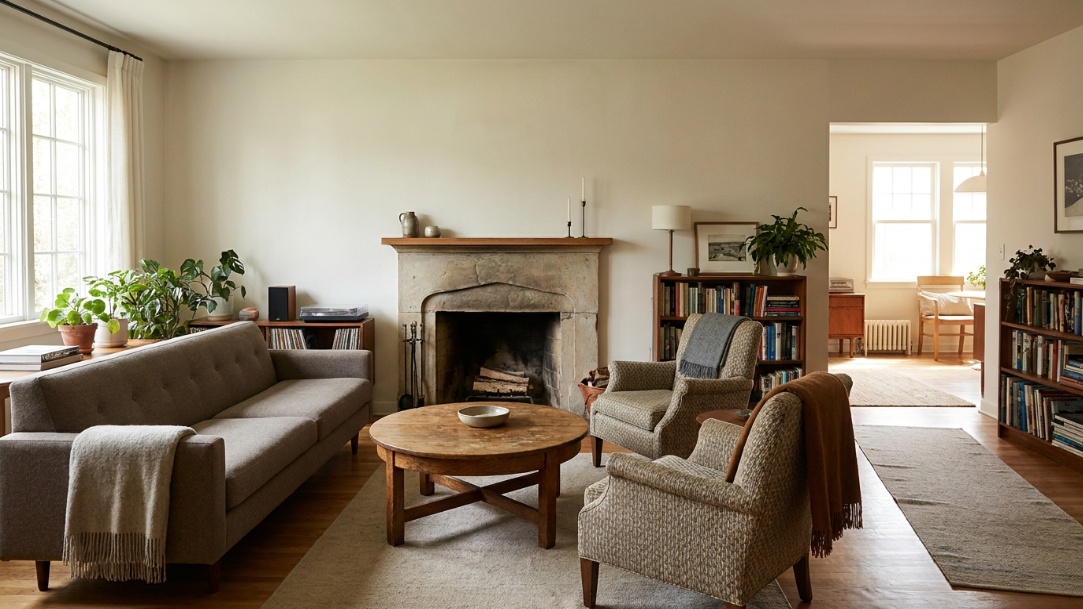
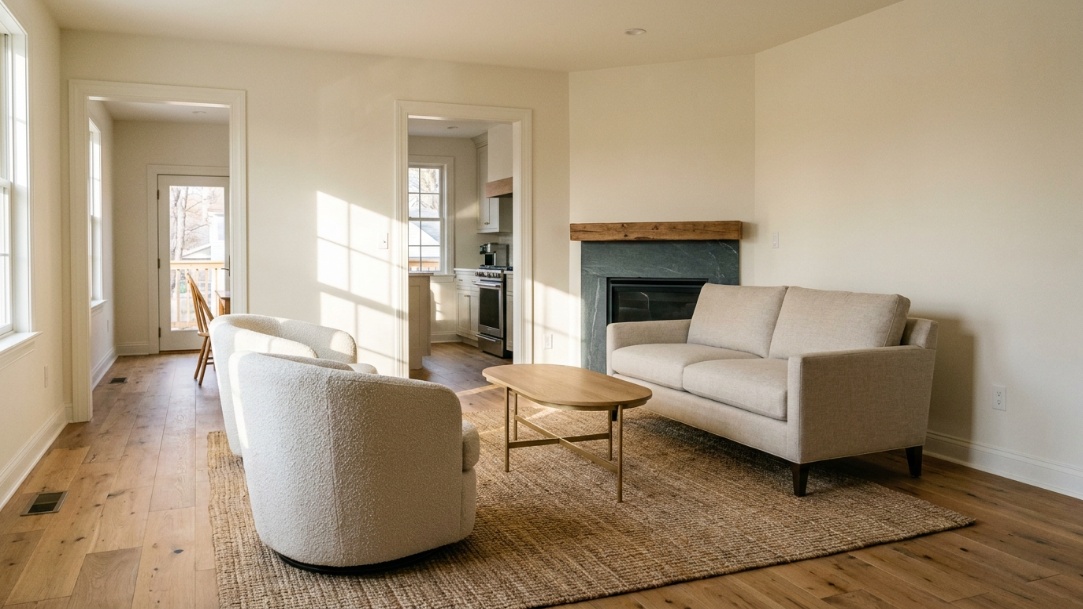
A corner fireplace creates a diagonal focal point, so the furniture can use a diagonal too. The cleanest option is often a sofa floating parallel to the fireplace face, with two chairs making a shallow U-shape. The chairs can turn toward the TV when needed, while the sofa still gives the fire visual importance.
Do not fill the corner next to the fireplace just because it exists. A narrow floor lamp, low bench, or a single basket may be enough. Heavy storage on both sides can make the fireplace look pinched and creates an oddly busy corner. If the room is small, a loveseat with two compact swivel chairs is usually easier to adjust than one large sectional.
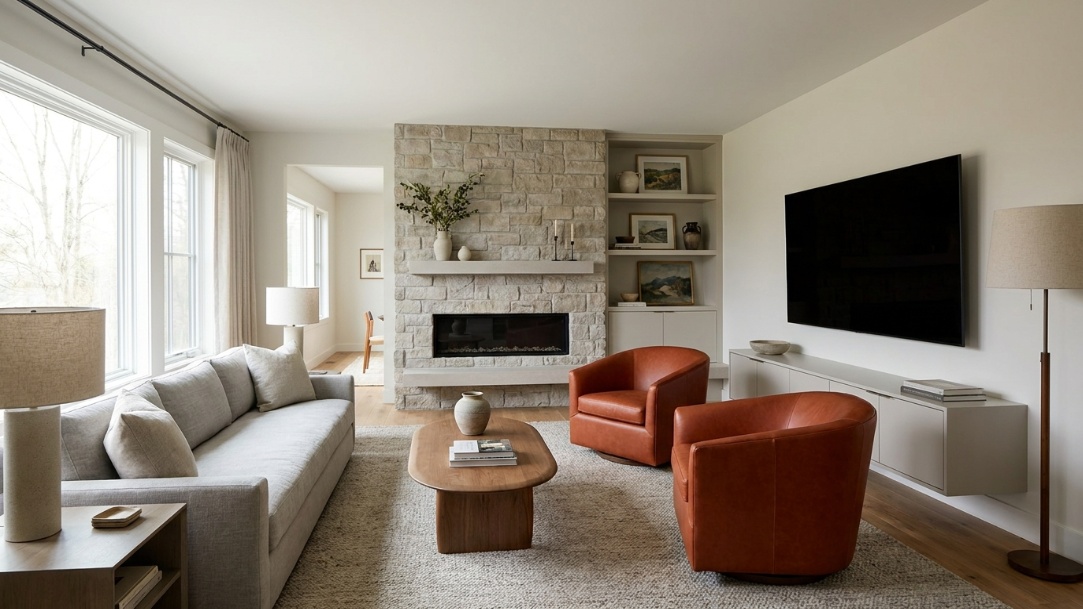
A fireplace and TV can share a room without pretending they are the same focal point. First decide which activity happens more often. If the room is mainly for television, give the TV the most comfortable direct view and let the fireplace provide atmosphere. If people gather around the fire and only sometimes watch TV, orient the core seating toward the fireplace and use chairs that can pivot toward the screen.
A TV above a fireplace can be visually tidy, but it is not automatically the right answer. Screen height, heat, glare, wiring, and the viewing distance all need to work for the specific firebox and seating arrangement. Check the television and fireplace manufacturers' installation requirements before choosing that arrangement.
When the fireplace and TV are on different walls, try this order: place the sofa for the primary activity, place two swivel chairs so they can acknowledge both focal points, then add a low table that does not interrupt the turn. A secondary chair is a better compromise than a sofa that faces neither wall well.
Long awkward living room layout ideas work when they break the corridor into useful stops. Put the main seating group in the section closest to the preferred focal point, then make the remaining end earn its place as a reading corner, game table, desk, or storage zone. A second rug, different lighting, or a pair of chairs can mark the shift without building a wall through the room.
Resist the common move of placing every item against the long walls. That keeps the center empty, exaggerates the room's length, and leaves the seating too far apart for conversation. Floating even one piece, such as the sofa, can create a shorter visual rectangle inside the larger room.
Use furniture that gives the route a destination. A console behind a floating sofa can separate the passage from the seating area. In a very narrow room, skip the console and keep the back of the sofa visually light. The right answer depends on the width you have after the sofa is in place, not on a universal furniture rule.
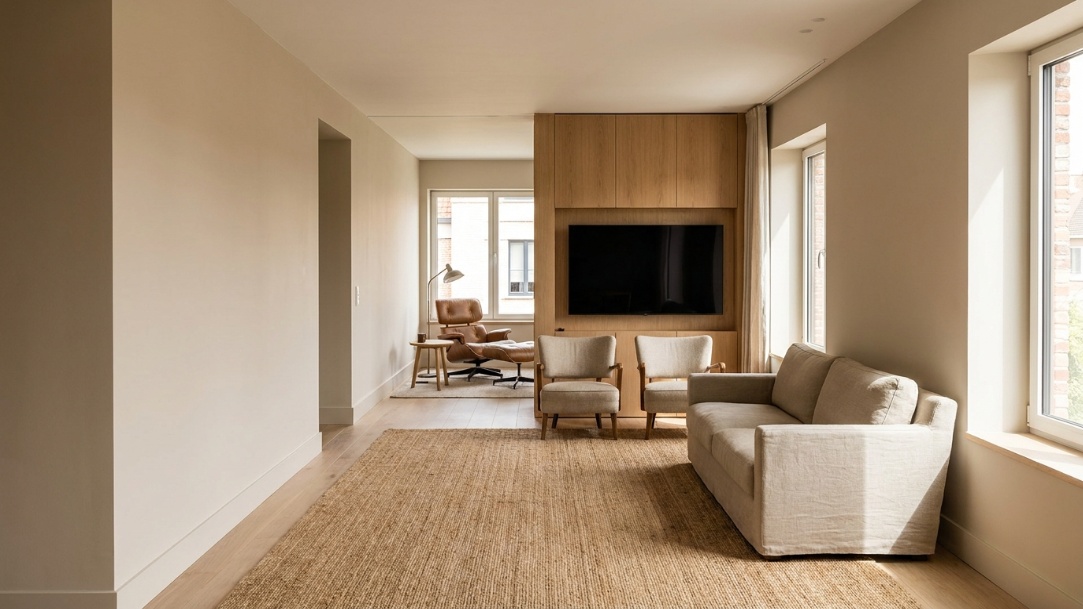
Rooms with several doors rarely have enough uninterrupted wall space for a conventional sofa-TV arrangement. The better move is to create a furniture island: sofa, chairs, and rug grouped in the middle or toward one side, with the traffic routes running around it. A sofa table behind the sofa can help only when it does not reduce the path to an obstacle course.
Use an odd corner for a job that does not demand deep floor space: a reading chair, a tall plant, a narrow bookcase, a floor lamp, or a small bar cabinet. Do not force a second full seating area into a corner that cannot support it. An unused-looking corner is often better than a crowded one that disrupts the room.
Accessibility needs make the room map even more important. If a renovation must meet accessibility requirements or a household member uses a mobility aid, verify the plan against the relevant local rules and the ADA Accessibility Standards rather than relying on a styled render.
Use three layout tests, not twenty vague variations. Test one plan that favors the fireplace, one that favors the TV, and one that creates the clearest walking route. Keep the same sofa size, doorway positions, windows, and fixed architecture in every version. That makes the comparison honest.
With Paintit's AI Living Room Design tool, upload a photo of the actual room and tell the model which parts must remain unchanged. A useful prompt names the focal point, the required route, the furniture you need, and the furniture that must not appear.
Redesign this real living room around the existing off-center fireplace. Keep the fireplace, windows, doorways, flooring, and room proportions unchanged. Add a compact sofa, two angled accent chairs, a round coffee table, and a large rug to create a conversation area without blocking the route between the doors. Use a warm contemporary style. Do not add furniture in front of the fireplace or block the walking path.
Keep the corner fireplace, TV wall, doorways, windows, and room structure unchanged. Create a compact living room with a sofa facing the TV and two swivel chairs angled toward the fireplace. Use an oval coffee table and leave a clear route from the entry to the kitchen. Keep the furniture realistic for this room size. Do not move the fireplace, put the TV above the fireplace, or add oversized furniture.
Keep this long narrow living room's windows, door locations, radiator, and floor unchanged. Create a main TV seating area at one end with a compact sofa and two chairs, then add a separate reading corner at the other end. Keep one continuous walking lane along the side of the room. Use two rugs to define the zones. Avoid lining all furniture against the long walls and avoid blocking any doorway.
For principles that apply after the awkward constraint is solved, see our guide to living room furniture layout ideas. It covers the broader decisions around conversation distance, rugs, furniture scale, and common arrangement mistakes.
Protect the main walking route first, then place the largest seating piece on the most usable wall. Use chairs to turn toward an off-center fireplace instead of forcing the sofa into perfect symmetry. The seating group needs to feel balanced from where people sit, not from the room's exact centerline.
A floating sofa with one or two chairs angled toward the corner fireplace is often more flexible than a sectional pressed into the room's perimeter. The layout should leave room for the fireplace visually and physically, while allowing people to enter and leave the seating group without cutting through it.
Choose the primary activity and give it the clearest seating position. Use swivel chairs, a secondary lounge chair, or a movable ottoman to make the other focal point available. Trying to make a fixed sofa face both walls equally usually creates a compromised layout for both watching and conversation.
Create two smaller zones across the room's length, such as a conversation area and a reading corner. Avoid a continuous line of furniture along the long walls. One floating sofa, a rug that defines the main group, and a deliberate walking lane can change how the whole room reads.
AI can help you compare furniture arrangements and visual directions in a photo of the real room. It cannot confirm exact furniture dimensions, heating clearances, electrical work, manufacturer requirements, or accessibility compliance. Use the render to decide what to measure, price, or discuss with a qualified professional.
The most successful awkward living room layout is not the one that hides every irregularity. It is the one that makes everyday movement simple and gives the fireplace, TV, furniture, and empty space clear roles. Map the fixed features, choose the conflict that matters most, and compare a small number of purposeful layouts before committing to a large piece of furniture.