
9 min. reading
Agentic AI in Furniture E-commerce: The Post-Search Future for Retailers

Yulii Cherevko
CEO paintit.ai
Page Contents:
- 1. Key Takeaways
- 2. What Agentic AI in Furniture E-commerce Means (Plain English)
- 3. Why it matters now (the real driver)
- 4. How it works (under the hood, in human terms)
- 5. A repeatable workflow (step-by-step)
- 6. Real-life scenario (show, don’t tell)
- 7. Where Paintit.ai fits (practical application)
- 8. Common mistakes (and how to avoid them)
- 9. FAQ
- 10. The Future of Furniture Retail: Embracing Autonomous Commerce
The days of endless scrolling and generic search results for furniture are numbered. The future of online furniture shopping lies in Agentic AI in furniture e-commerce, where intelligent agents proactively understand user intent and guide them to the perfect pieces. This shift to "post-search" commerce, enabled by AI-driven shopping agents, promises a more intuitive, personalized, and efficient experience than ever before. This digital transformation in the furniture industry means customers will spend less time searching and more time receiving hyper-relevant recommendations and even automated furniture purchases. To experience a glimpse of this future, try it now.
Key Takeaways
- Agentic AI shifts from user search to AI agents understanding and acting on specific intent.
- This "post-search" model offers hyper-personalization and seamless shopping journeys for furniture.
- Retailers can achieve higher conversions and reduced returns by adopting agent-ready strategies.
- Optimizing product catalogs with structured data and embracing API-first architecture are crucial.
- Integrating AI interior design visualization tools provides vital data for AI agents and enhances the customer experience.
- Agentic commerce streamlines complex furniture orders and improves the overall shopping experience.
- Preparing for agentic AI now is essential for competitive advantage in furniture retail.
What Agentic AI in Furniture E-commerce Means (Plain English)

At its core, Agentic AI in furniture e-commerce refers to systems where AI acts as a proactive, autonomous "agent" on behalf of a shopper. Instead of simply responding to keywords, these AI-driven shopping agents understand nuanced intent, anticipate needs, and execute tasks – from finding the right sofa to completing a multi-item room design and purchase. It's a fundamental pivot from "you search, we show" to "we understand, we find, we buy."
What it is NOT:
- It's not just better search filters: While existing e-commerce uses AI for recommendations, agentic AI goes further by *acting* on those recommendations autonomously or with minimal user input.
- It's not just a chatbot: While agentic AI can interface through conversational UIs, its core power lies in its ability to process complex data, make decisions, and interact with various systems to fulfill a goal, rather than just answering questions.
- It's not about replacing human creativity: Agentic AI assists and streamlines the practicalities of furniture selection and purchasing, freeing human designers and shoppers to focus on creative vision.
Why it matters now (the real driver)
The rise of agentic AI is a response to persistent pain points in the furniture e-commerce experience: decision fatigue, high return rates, and the sheer complexity of furnishing a space. Traditional search-based shopping often leads to an overwhelming number of choices, mismatched aesthetics, and costly errors when items don't fit or look right in a home. This translates directly into workflow friction for consumers and significant time/cost pressures for retailers.
Consumers are increasingly accustomed to intelligent, personalized experiences in other domains (streaming, travel). The expectation for a seamless, guided shopping journey, particularly for high-consideration purchases like furniture, is growing. For AI for furniture retailers, embracing this shift means:
- Reducing friction: Automating furniture purchases removes steps, making buying effortless.
- Minimizing returns: Better fit and visual accuracy lead to significantly lower return rates.
- Driving conversion: Hyper-personalized suggestions align perfectly with buyer intent, leading to faster decisions.
- Operational efficiency: Streamlined order processing and reduced customer service queries for common issues.
This isn't just about incremental improvements; it's about a fundamental digital transformation in the furniture industry that addresses core frustrations for both buyer and seller.
How it works (under the hood, in human terms)

Agentic AI operates as a sophisticated pipeline, moving from understanding complex intent to executing specific actions. Here's a simplified breakdown:
- Intent Capture & Context Building: The process begins with understanding the user's implicit and explicit needs. This goes beyond keywords to incorporate visual preferences (e.g., from uploaded room photos or design inspirations), lifestyle data, budget, spatial constraints, and existing furniture styles. Tools integrating AI interior design to sales funnel capture this rich context.
- Information Retrieval & Data Fusion: The AI agent queries various data sources, including the retailer's furniture catalog optimized for AI, external product databases, and interior design style guides. These catalogs must be machine-readable, with structured data (dimensions, materials, colors, textures, brand, price, sustainability metrics) and high-quality 3D models or photorealistic renders. Protocols like the Model Context Protocol (MCP) implementation ensure consistent data interpretation.
- Constraint Satisfaction & Generation: Based on the gathered intent and retrieved data, the agent applies complex algorithms to filter, combine, and even generate potential solutions. For instance, if a user wants a "mid-century modern living room with a focus on sustainable materials," the agent selects pieces that fit all these criteria, perhaps using a generative AI to visualize how they look together.
- Simulation & Validation: Before presenting options, the agent can use simulation tools (like virtual staging or AR) to "test" how furniture fits in the user's space, identifying potential issues like scale, color clash, or obstructed pathways. This phase is crucial for reducing furniture return rates with AI.
- Iteration & Refinement: The agent presents curated options, gathers feedback (explicit "I like this" or implicit via interaction patterns), and refuses its recommendations. This iterative loop allows the agent to learn and adapt, continuously improving its understanding of the user's evolving preferences.
- Action & Transaction: Once a satisfactory solution is found, the agent can initiate and manage the purchase process, potentially automating complex furniture orders across multiple vendors, handling logistics, and processing payments. API-first furniture e-commerce architectures are critical here, allowing seamless communication between the agent, product inventory, CRM, and payment systems.
Typical failure modes include incomplete or inaccurate product data, agents misinterpreting nuanced human language, or a lack of robust API connections between different e-commerce systems, leading to a fragmented customer experience.
A repeatable workflow (step-by-step)
Implementing agentic capabilities requires a structured approach to make your virtual interior design commerce ecosystem ready. This workflow focuses on preparing your data and systems for AI agents to interact efficiently.
- Audit and Standardize Product Data:
- Input: Existing product catalog data (SKUs, descriptions, images).
- What to control: Data completeness, accuracy, and standardization across all attributes (dimensions, materials, colors, styles, care instructions). Ensure every product has a unique identifier and rich metadata.
- Output: A clean, harmonized, machine-readable product dataset.
- Pitfall: Inconsistent terminology ("grey" vs. "gray"), missing dimensions, low-resolution imagery.
- Paintit.ai shortcut: Use AI-driven image analysis tools to identify missing visual attributes and tag product images consistently.
- Generate AI-Ready Visual Assets:
- Input: High-resolution product images, 3D models (if available).
- What to control: Creation of diverse lifestyle images, room mockups, and virtual staging scenes for each product. Ensure visual consistency and photorealism.
- Output: An extensive library of contextualized product visuals.
- Pitfall: Generic white-background images that lack context, misrepresenting scale or texture.
- Paintit.ai shortcut: Leverage AI Rendering to create photorealistic product visualizations in various interior styles.
- Implement or Enhance API-First Architecture:
- Input: Existing e-commerce platform, PIM (Product Information Management) system, CRM.
- What to control: Development of robust, well-documented APIs that allow external AI agents to query product data, check inventory, initiate orders, and access customer preferences.
- Output: A flexible, interconnected e-commerce ecosystem.
- Pitfall: Monolithic systems that are difficult to integrate, poor API documentation hindering adoption.
- Paintit.ai shortcut: Consider Paintit.ai's integration capabilities for seamless data flow between design visualization and your e-commerce APIs.
- Integrate AI Design and Visualization Tools:
- Input: User-provided room photos, style preferences, or spatial data.
- What to control: The connection between visualization tools and your product catalog. Ensure that designs created in these tools can directly link back to purchasable SKUs.
- Output: A unified design-to-purchase funnel.
- Pitfall: Visualization tools that create beautiful designs but don't easily translate to actual product availability or purchase.
- Pro tip: When using tools like Paintit.ai's AI Room Design, feed the generated design context (style, colors, furniture types) directly into your customer's profile for future agent interactions.
- Pilot AI Agent Interactions:
- Input: Test customer profiles with varied needs, budgets, and styles.
- What to control: Simulation of agent-customer interactions. Evaluate the agent's ability to understand intent, provide relevant recommendations, and complete purchases. Monitor conversion rates and user feedback.
- Output: Refined AI agent logic and improved customer journeys.
- Pitfall: Agents that provide irrelevant suggestions or struggle with complex, multi-faceted requests.
- Paintit.ai shortcut: Use Paintit.ai's visual output as a benchmark for how accurately an AI agent can interpret and fulfill a design brief.
| Step | Input | What to Control | Output | Pitfall | Paintit.ai Shortcut |
|---|---|---|---|---|---|
| 1. Data Harmonization | Raw product data | Data accuracy, consistency, richness | Machine-readable product catalog | Inconsistent attributes, missing details | AI tagging and classification of product features. |
| 2. Visual Asset Generation | Product images, 3D models | Visual quality, diversity, context | Extensive lifestyle image library | Generic visuals, poor representation | Use AI Rendering to generate realistic room settings. |
| 3. API Integration | E-commerce platform, PIM | API robustness, documentation, security | Seamless system interconnectivity | Data silos, integration difficulties | Leverage Paintit.ai's API for design-to-product mapping. |
| 4. AI Design Tool Linking | User design preferences | Design-to-SKU mapping, user feedback | Integrated design & shopping experience | Disconnected design from purchasable items | Use AI Room Design output to inform agent product search. |
| 5. Agent Simulation | Test customer scenarios | Agent's intent understanding, actions | Optimized agent logic, improved journeys | Irrelevant recommendations, failed purchases | Validate agent choices against Paintit.ai visual outputs. |
Real-life scenario (show, don’t tell)

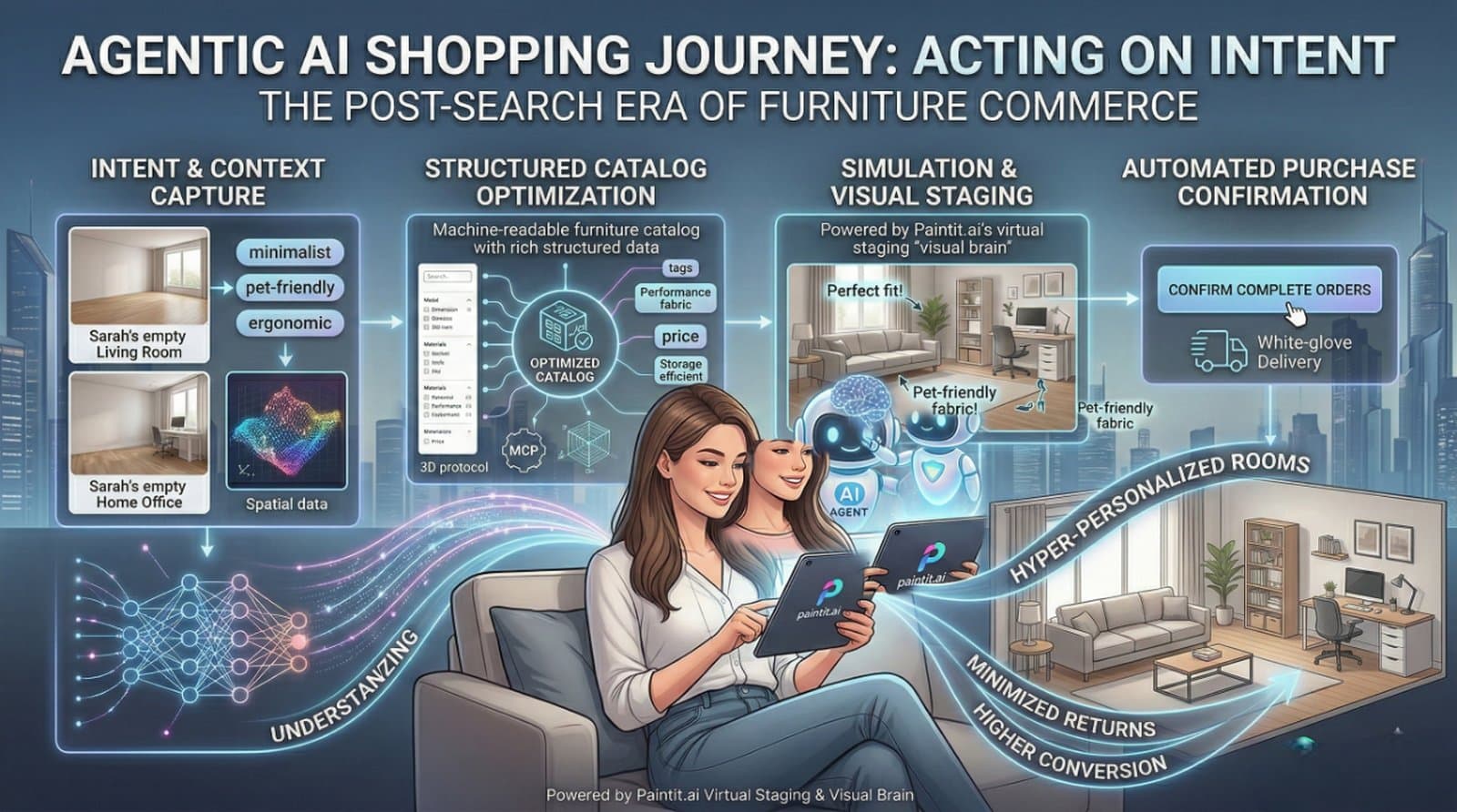
Consider Sarah, a young professional moving into a new apartment, tasked with furnishing her living room and home office from scratch. She has a limited budget for each room, prefers a minimalist aesthetic, needs pet-friendly fabrics for her dog, and requires an ergonomic desk setup.
Constraints:
- Living Room: $2,500 budget, minimalist style, pet-friendly sofa, fits a small space.
- Home Office: $1,500 budget, functional, ergonomic, integrates storage, matches minimalist aesthetic.
Steps an AI agent would take (enabled by retailer readiness):
- Initial Input: Sarah uploads photos of her new apartment's empty living room and office, specifies her style as "minimalist," and mentions "pet-friendly" and "ergonomic" needs.
- Intent Processing: The AI agent analyzes the room dimensions from the photos, understands "minimalist," "pet-friendly fabric," "ergonomic," and the budget constraints. It identifies her need for complete room solutions.
- Catalog Query: The agent queries the retailer's furniture catalog optimized for AI, filtering for minimalist-style sofas with performance fabrics within the living room budget, and ergonomic desks/chairs with integrated storage within the office budget. It also checks inventory and delivery times.
- Virtual Staging & Visualization: Using integrated virtual interior design commerce tools (like Paintit.ai), the agent generates 3-5 distinct minimalist living room concepts and 2-3 ergonomic home office layouts, visually placing the recommended furniture directly into Sarah's uploaded room photos. It shows scale, color palettes, and how pieces complement each other.
- Refinement: Sarah reviews the visualizations. She "likes" a specific sofa fabric and desk chair, but requests a darker wood finish for the coffee table and more enclosed storage for the office.
- Automated Purchase: The agent updates the recommendations, re-generates the visuals, and once approved by Sarah, compiles a single shopping cart for both rooms. With a single click, Sarah confirms the automating furniture purchases, including white-glove delivery and assembly.
Success Criteria:
Sarah receives perfectly coordinated, functional, and budget-compliant furniture, delivered and assembled without the typical stress of searching, comparing, and coordinating purchases, all with minimal personal effort and a high degree of confidence. The retailer benefits from a high conversion rate and low risk of returns.
Where Paintit.ai fits (practical application)
Paintit.ai is a pivotal component in the agentic commerce ecosystem, bridging the gap between abstract design intent and tangible visual reality. It excels where spatial understanding, aesthetic judgment, and photorealistic visualization are paramount.
Paintit.ai is fastest when:
- Translating text prompts into visual concepts: Rapidly generating diverse design ideas from simple descriptions.
- Virtually staging rooms: Placing furniture and decor into existing photos to assess fit, style, and scale instantly.
- Experimenting with materials and finishes: Visualizing how different fabrics, woods, or paints look in a real-world context.
- Generating high-quality marketing assets: Creating lifestyle images for product catalogs without physical staging.
While Paintit.ai dramatically streamlines the visualization and conceptualization phases, manual work remains essential for specific aspects:
- Exact physical measurements: While AI can estimate, precise, on-site measurements for custom built-ins or tight spaces still require human verification.
- Structural constraints: Assessing wall integrity for heavy mounted items, or verifying load-bearing capabilities.
- Permits and regulations: Navigating local building codes or homeowner association rules for modifications.
- Highly complex custom fabrication: Intricate, one-off furniture pieces may require detailed human design and engineering.
Paintit.ai acts as the visual brain for the agent, providing the essential "eyes" that allow the AI to see and understand spatial and aesthetic relationships, drastically improving the quality of recommendations and the confidence in virtual interior design commerce. Retailers can integrate Paintit.ai capabilities into their existing systems as part of their broader Paintit.ai business solutions strategy.
Common mistakes (and how to avoid them)
Here are common pitfalls when moving towards post-search e-commerce with agentic AI:
- Underestimating Data Quality:
- Mistake: Assuming existing product descriptions are sufficient for AI agents. Generic, unstructured data ("beautiful sofa") is unusable.
- Fix: Invest heavily in a Product Information Management (PIM) system. Ensure every product has detailed, structured attributes (dimensions, material composition, care instructions, style tags, weight).
- Check next: Can your PIM export data in a consistent JSON or XML format with all key attributes?
- Neglecting API-First Architecture:
- Mistake: Trying to bolt AI agents onto a monolithic e-commerce platform with limited integration points.
- Fix: Adopt an API-first furniture e-commerce strategy. Ensure robust, well-documented APIs exist for inventory, pricing, order placement, and customer data.
- Check next: Can a third-party AI agent seamlessly query your inventory and place an order without human intervention?
- Ignoring Visual Context:
- Mistake: Focusing only on textual data for AI, without integrating visual understanding.
- Fix: Implement AI-powered visualization tools (like Paintit.ai) that allow customers to see products in their own spaces. This provides rich visual data for agents to learn from.
- Check next: Does your customer journey allow for visual uploads and AI-generated staging *before* product recommendations?
- Lack of Iterative Feedback Loops:
- Mistake: Deploying an AI agent and expecting it to be perfect from day one, without a mechanism for learning and refinement.
- Fix: Build explicit and implicit feedback mechanisms into the agent's interaction. Allow users to "like," "dislike," or refine suggestions, and track conversion paths.
- Check next: Can you easily analyze which agent recommendations led to purchases and which did not, and use that data to retrain the agent?
- Over-automating Without Human Oversight:
- Mistake: Giving AI agents too much autonomy in complex situations, leading to errors or frustrating experiences.
- Fix: Design agentic systems with clear escalation paths to human customer service for edge cases, complex problem-solving, or emotional queries.
- Check next: Do customers feel heard and supported even when the AI agent can't fulfill their request?
- Underestimating Security and Privacy:
- Mistake: Collecting vast amounts of customer data (visual, preference, payment) without robust security protocols.
- Fix: Implement strong data encryption, adhere to privacy regulations (e.g., GDPR, CCPA), and use secure methods for tokenized payments for AI agents.
- Check next: Is your data infrastructure compliant with current data privacy laws?
- Ignoring Logistics and Fulfillment Readiness:
- Mistake: Focusing solely on the front-end AI agent experience, while the back-end fulfillment struggles with the new order types.
- Fix: Ensure your warehouse, shipping, and installation partners are ready to handle potentially more complex, multi-vendor, and highly personalized orders generated by AI agents.
- Check next: Can your logistics system efficiently track and manage an order for a full room's worth of furniture from multiple brands?
FAQ
Q1: What's the main difference between current e-commerce and agentic commerce?
A1: Current e-commerce relies on users actively searching and browsing products based on keywords. Agentic commerce uses AI agents that proactively understand user intent, curate highly personalized recommendations, and can even initiate and automate the purchase process, effectively bypassing traditional search.
Q2: How can AI interior design tools work with agentic AI?
A2: Tools like Paintit.ai provide rich visual context. Users can upload room photos or generate design concepts, and the AI agent can interpret these visuals to understand style preferences, spatial constraints, and existing aesthetics. This visual data then informs more accurate product recommendations and enables reducing furniture return rates with AI by ensuring better fit and style match before purchase. To visualize how your future home can look with AI, visit Paintit.ai's AI Virtual Staging.
Q3: Will agentic AI replace human sales staff in furniture retail?
A3: Agentic AI is designed to augment, not entirely replace, human roles. It handles routine inquiries, guides personalized discovery, and automates straightforward purchases, freeing human sales staff for more complex design consultations, bespoke client relationships, and addressing unique customer challenges that require empathy and nuanced judgment.
Q4: Is my furniture catalog ready for AI agents?
A4: Most existing furniture catalogs need significant optimization. For AI agents, catalogs require detailed, structured, machine-readable data (dimensions, materials, color codes, style tags, care instructions) and high-quality, contextualized imagery (lifestyle photos, 3D models). Furniture catalog optimization for AI is a critical first step.
Q5: How does agentic AI help automate complex furniture orders?
A5: An AI agent can manage multi-item purchases across different categories and even vendors, coordinating styles, ensuring compatibility, checking inventory, and streamlining the checkout and delivery process. This ability to handle automating complex furniture orders significantly reduces user effort and potential errors.
Q6: What is an Agentic Commerce Protocol (ACP)?
A6: An Agentic Commerce Protocol (ACP) is a set of standardized rules and data formats that allow different AI agents and e-commerce platforms to communicate and interact seamlessly. It ensures interoperability, so an AI agent from one platform can understand and act on product data from a different retailer's system.
The Future of Furniture Retail: Embracing Autonomous Commerce
The shift to Agentic AI in furniture e-commerce is not just an incremental upgrade; it represents a fundamental re-imagining of how people discover, design, and purchase furniture. For AI for furniture retailers, this means moving beyond static product listings to dynamic, intent-driven interactions. By prioritizing digital transformation in the furniture industry and integrating tools for AI interior design to sales funnel, retailers can meet evolving consumer expectations, improve furniture e-commerce conversion with AI design, and unlock unprecedented efficiencies. The future of furniture retail is autonomous, personalized, and visually driven.
Trending
7 Best HomeDesignsAI Alternatives in 2026: Detailed Review & Comparison
How to Use AI to Decorate a Room: Your Visual Design Partner
Dopamine Decor Trend: How to Design a Home That Sparks Joy
AI Tools for Generating Interior Design Mockups for Real Estate Listings Automation: Top Picks in 2026
Interior Design Trends Winter 2025-2026 & H1 Forecast: The Era of Emotion
Related articles
9 min read
Agentic AI in Furniture E-commerce: The Post-Search Future for Retailers
Explore how Agentic AI and shopping agents revolutionize furniture e-commerce. Learn to optimize catalogs and boost conversions in the post-search era
Yulii Cherevko
CEO paintit.ai
8 min read
7 Best HomeDesignsAI Alternatives in 2026: Detailed Review & Comparison
Discover the best HomeDesignsAI competitors in 2026. Compare Paintit.ai, RoomGPT, and pro tools to find your perfect fit. Start visualizing your ideas now!
Yulii Cherevko
CEO paintit.ai

12 min read
How to Use AI to Decorate a Room: Your Visual Design Partner
Learn how to use AI to decorate a room effortlessly. Upload a photo, test styles, and visualize your dream space with Paintit.ai. Try it today!
Yulii Cherevko
CEO paintit.ai

5 min read
Dopamine Decor Trend: How to Design a Home That Sparks Joy
Discover the Dopamine Decor trend! Learn how to use vibrant colors, nostalgia, and neuroaesthetics to design a home that sparks joy and boosts your mood
Yulii Cherevko
CEO paintit.ai
11 min read
AI Tools for Generating Interior Design Mockups for Real Estate Listings Automation: Top Picks in 2026
Discover top AI tools for generating interior design mockups. Learn how to automate real estate listings, boost CTR, and save 90% on staging costs with AI
Yulii Cherevko
CEO paintit.ai

9 min read
Interior Design Trends Winter 2025-2026 & H1 Forecast: The Era of Emotion
Discover the defining interior design trends for Winter 2025/2026. From Moody Palettes and Warm Minimalism to the explosion of Dopamine Decor, explore the forecast with Paintit.ai
Yulii Cherevko
CEO paintit.ai