5 min. reading
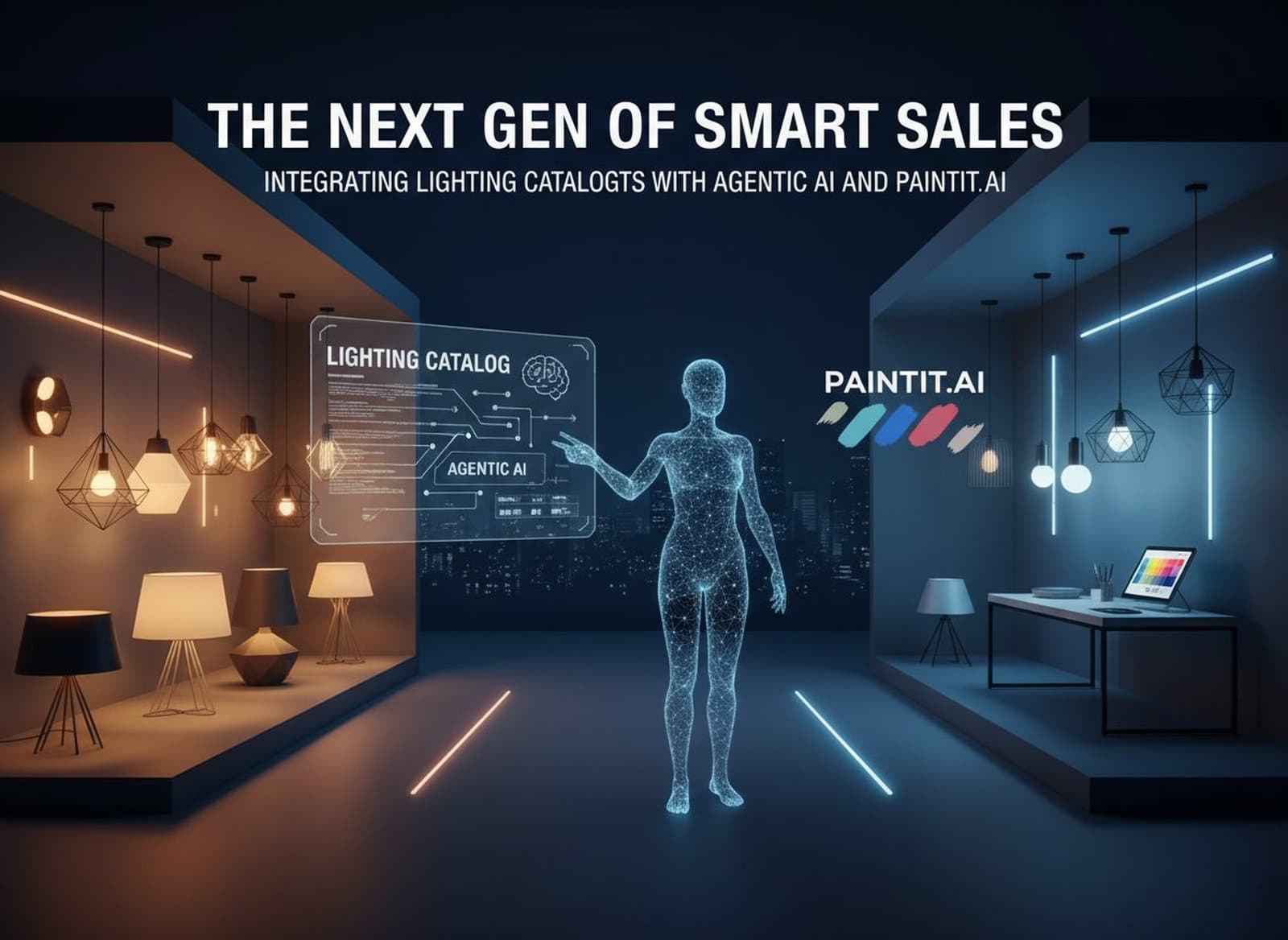
The Next Gen of Smart Sales: Integrating Lighting Catalogs with Agentic AI and Paintit.ai

Yulii Cherevko
CEO paintit.ai
Page Contents:
- 1. The Evolving Landscape of Lighting Sales
- 2. What is Agentic AI and Why It Matters for Lighting Sales
- 3. Bridging Catalogs and Customer Needs with AI
- 4. Enhancing the Sales Consultation with Paintit.ai
- 5. Implementing AI in Your Lighting Sales Workflow
- 6. The Future of Smart Lighting Sales
- 7. Frequently Asked Questions about Agentic AI for Lighting Retail
The way lighting is sold is undergoing a profound transformation, moving beyond static catalogs and passive showrooms. The next generation of smart sales lighting integrates sophisticated agentic AI with comprehensive digital catalogs, enabling sales professionals to offer unparalleled personalization and efficiency. Tools like Paintit.ai are at the forefront, allowing clients to visualize complex lighting solutions in their own spaces with photorealistic accuracy. This synergy empowers sales teams to understand nuanced customer needs, present tailored recommendations instantly, and simulate the tangible impact of light, dramatically shortening sales cycles and elevating the customer experience.
The Evolving Landscape of Lighting Sales
The lighting industry operates on a paradox: vast catalogs offer limitless possibilities, but this abundance often leads to specification errors, protracted decision-making, and client overwhelm. Traditional sales processes struggle with the sheer volume of SKUs, varying technical specifications, and the subjective nature of aesthetic preferences. Sales agents spend valuable time sifting through data, creating mock-ups, and managing complex orders, often resulting in high return rates when the actual product doesn't meet expectations.
This environment highlights the urgent need for a digital transformation in the lighting industry. Businesses require systems that can intelligently navigate complex product data, understand visual intent, and translate technical specifications into tangible, personalized solutions. The goal is to move beyond simple product display to truly responsive, AI-driven lighting e-commerce and consultation.
What is Agentic AI and Why It Matters for Lighting Sales
The shift toward smarter sales hinges on a particular class of artificial intelligence: agentic AI. Unlike predictive algorithms that merely suggest based on past data, agentic AI systems are designed to understand context, make independent decisions, and take actions to achieve complex goals, demonstrating a degree of autonomy.
Defining Agentic AI in Design
Agentic AI, in the context of interior design and sales, refers to intelligent software entities that can process information, reason about it, and execute tasks without constant human oversight. For lighting, this means an AI agent can ingest detailed client requirements-room dimensions, desired ambiance, existing furniture styles, even specific Kelvin temperatures-and autonomously interact with a vast lighting catalog to find optimal solutions. This capability moves beyond simple filtering; it's about dynamic problem-solving.
Capabilities Beyond Visualization: Autonomy and Decision-Making
While visualization tools are crucial, agentic AI adds a layer of intelligent automation. Imagine an AI agent not only showing a pendant light in a virtual kitchen but also automatically assessing its lumen output against room size, ensuring compliance with local energy codes, and even cross-referencing material finishes with existing appliances to maintain design cohesion. This form of automated lighting specification for interiors actively reduces the chance of human error and ensures technical compatibility, moving the sales process from reactive to proactive. It underpins the future of smart lighting sales by providing more than just suggestions-it provides verifiable, context-aware solutions.
Bridging Catalogs and Customer Needs with AI
The true power of agentic AI lies in its ability to act as an intelligent intermediary, effectively translating diverse customer needs into concrete product selections from expansive digital libraries. This dramatically streamlines the sales funnel, making complex product configurations accessible and intuitive.
Intelligent Catalog Curation and Search
Integrating lighting catalogs with AI agents begins with a foundational step: optimizing product data. This requires a Machine-readable lighting specifications framework, often adopting a MCP for lighting product data (Model Context Protocol). This protocol ensures that every fixture, bulb, and component is described not just by text, but by structured data points that AI can understand and process-dimensions, materials (brass, matte black, frosted glass), lumen output, CRI, color temperature (warm white, cool white, daylight), wattage, and even 3D models.
With such granular data, AI agents can perform intelligent searches and curation, identifying fixtures that meet precise aesthetic and technical criteria. This is smart lighting catalog optimization for AI, transforming a static database into a dynamic, responsive resource.
Personalized Lighting Recommendations at Scale
Agentic AI can analyze a client's specific input-a photo of their living room, verbal descriptions of their style, or even inspiration images-and generate personalized lighting solutions based on 3D design data. Instead of overwhelming a client with an entire catalog, the AI agent presents a curated selection that directly addresses their needs, from ambient lighting to accent and task lighting.
This includes forming AI-powered smart lighting bundles that pair complementary fixtures, bulbs, and controls, ensuring a cohesive and functional lighting scheme. By processing visual intent data for lighting brands, AI agents can infer design preferences and suggest not just products, but entire design narratives that resonate with the client, all while automating commercial lighting sales via AI. This level of personalization significantly elevates the customer experience and builds trust.
Enhancing the Sales Consultation with Paintit.ai
While agentic AI excels at identifying the right products, the next challenge is helping clients visualize those products in their unique spaces. This is where Paintit.ai provides a critical advantage, turning abstract recommendations into tangible realities. Paintit.ai serves as the visualization engine, allowing sales professionals to conduct highly interactive and personalized consultations.
Virtual Staging and Photorealistic Previews
Sales professionals can upload a client's room photo or a 3D model into Paintit.ai. The platform's AI Virtual Staging capabilities then virtually place recommended lighting fixtures into the scene with photorealistic accuracy. This means a client can see how a specific chandelier looks in their dining room or how wall sconces impact their hallway before committing to a purchase. This direct visual feedback addresses a major pain point, reducing lighting returns with AI visualization by managing expectations upfront.
Interactive Design Exploration with AI
Paintit.ai's AI Room Design tools go beyond static images. Clients can dynamically swap out different pendant lights, try various floor lamps, or explore recessed lighting options in real-time. This interactive exploration empowers clients to participate actively in the design process, making them feel invested and confident in their choices. The ability to manipulate design elements virtually fosters a collaborative environment, accelerating decision-making.
Testing Light Temperatures and Fixture Styles
The impact of light temperature (Kelvin) and style on a room's ambiance is profound yet often hard to convey. With Paintit.ai, sales agents can simulate how a 2700K warm white bulb differs from a 4000K neutral white in the client's space. They can demonstrate how light interacts with materials like polished brass, brushed nickel, or frosted glass. This detailed simulation not only showcases the product but also educates the client, ensuring they choose fixtures that align with both their aesthetic and functional needs, effectively eliminating lighting specification errors related to visual outcome.
Implementing AI in Your Lighting Sales Workflow
Adopting agentic AI and advanced visualization tools requires a strategic approach. It's not just about technology; it's about integrating new capabilities into existing sales frameworks and empowering your team.
Data Integration: Connecting Catalogs and CRMs
The foundation of any successful AI integration is robust data. Your lighting catalog needs to be more than just product listings; it must be a rich, machine-readable dataset ready for AI consumption. This often involves utilizing a Paintit.ai lighting integration API to connect your product database with AI platforms and your CRM. Seamless integration ensures that AI-generated recommendations and client interactions are logged, creating a comprehensive customer profile for AI agents for smart home lighting procurement and other specialized sales. This data flow also supports automating commercial lighting sales via AI by ensuring real-time product availability and pricing information.
Training Your Sales Team for AI Collaboration
AI is a powerful assistant, not a replacement. Sales professionals need training to effectively leverage agentic AI tools. This includes understanding how to input client data efficiently, interpret AI-generated recommendations, and use visualization platforms like Paintit.ai to guide client discussions. The focus shifts from manual product searching to consultative selling, where the sales agent becomes an expert interpreter of AI insights, delivering superior service. This adaptation is crucial for the future of smart lighting sales.
Measuring Success: ROI and Customer Satisfaction
Implementing AI in sales must be accompanied by clear metrics. Track key performance indicators such as reduced sales cycle times, increased average order value (from AI-powered smart lighting bundles), lower return rates, and improved customer satisfaction scores. Gather feedback from both sales teams and clients to refine the AI's performance and the integration workflow, ensuring continuous improvement in personalization and lighting solutions based on 3D design data.
The Future of Smart Lighting Sales
The trajectory of lighting retail is clear: toward hyper-personalization, automation, and immersive visualization. Agentic AI, combined with platforms like Paintit.ai, is not merely optimizing current sales processes; it's redefining them. We are moving toward a reality where complex lighting projects are spec'd, visualized, and sold with unprecedented speed and accuracy, powered by AI that understands nuance as well as data.
This means a future where sales teams are freed from repetitive tasks, focusing instead on building client relationships and addressing unique design challenges. It's a future where every client receives a perfectly tailored, visually compelling lighting solution, driving both satisfaction and sustainable business growth in the evolving landscape of smart sales lighting.
Frequently Asked Questions about Agentic AI for Lighting Retail
Q: How can agentic AI specifically improve lighting sales beyond just showing pretty pictures?
A: Agentic AI can autonomously analyze client needs, cross-reference them with vast lighting catalogs, generate personalized recommendations, and even simulate different lighting scenarios, acting as an intelligent sales assistant that speeds up the decision-making process and enhances personalization. This includes automated technical lighting selection and eliminating lighting specification errors.
Q: What kind of data is needed to effectively train an AI for lighting sales?
A: High-quality catalog data (images, specs, dimensions, materials, color temps, CRI), historical sales data, customer interaction logs (from CRM), and potentially client-provided room photos or style preferences are crucial for training. Comprehensive smart lighting catalog optimization for AI is key.
Q: Is integrating AI with lighting catalogs complex for businesses?
A: The complexity varies based on the depth of AI functionality desired and the existing infrastructure. Basic integration might involve API connections to existing catalogs and CRMs. Advanced agentic AI and seamless visualization tools like Paintit.ai require more robust setup, but platforms aim to simplify this integration through developer-friendly APIs and guided setup processes.
Q: How does Paintit.ai fit into an AI-driven lighting sales strategy?
A: Paintit.ai acts as the critical visualization layer. It takes AI-generated recommendations and client input to provide photorealistic previews, allowing clients to see exactly how different fixtures and light temperatures will look and feel in their space before purchasing. This greatly contributes to reducing lighting returns with AI visualization.
Q: What are the key benefits of using AI for personalized lighting recommendations?
A: Key benefits include increased customer satisfaction through tailored suggestions, faster sales cycles by reducing manual searching, improved conversion rates by addressing specific needs effectively, and the ability to upsell by suggesting complementary fixtures or optimized lighting schemes. This drives the future of smart lighting sales.
Trending
Challenges and Limitations of Integrating AI into Architectural Design
7 Best Styldod Alternatives & Competitors in 2026: Full Review
The Next Gen of Smart Sales: Integrating Lighting Catalogs with Agentic AI and Paintit.ai
Looking for HomeByMe Alternatives? Top AI Tools for Instant 3D Design & Rendering
Best AI Bathroom Design App: Visualize Your Sanctuary in Seconds
Related articles

7 min read
Best AI for Furniture Design: The Ultimate 2026 Pro Guide
Discover the best AI for furniture design in 2026. Compare Paintit.ai, Planner 5D, and more to optimize your 3D modeling, ideation, and sustainable workflows
Yulii Cherevko
CEO paintit.ai

7 min read
Challenges and Limitations of Integrating AI into Architectural Design
Explore the limitations of AI in architecture: from algorithmic bias and the 'black box' problem to BIM integration hurdles and evolving ethical legal risks
Yulii Cherevko
CEO paintit.ai

8 min read
7 Best Styldod Alternatives & Competitors in 2026: Full Review
Discover the top Styldod alternatives for AI virtual staging in 2026. Compare Paintit.ai, Collov, and more to find the best tool for photorealistic property design
Yulii Cherevko
CEO paintit.ai
5 min read
The Next Gen of Smart Sales: Integrating Lighting Catalogs with Agentic AI and Paintit.ai
Discover how Agentic AI and Paintit.ai transform lighting sales. Enhance personalization, reduce returns, and automate catalogs for the next gen of retail.
Yulii Cherevko
CEO paintit.ai
8 min read
Looking for HomeByMe Alternatives? Top AI Tools for Instant 3D Design & Rendering
Searching for a HomeByMe alternative? Explore the best AI-powered tools for instant interior design and photorealistic rendering. Find your perfect fit with Paintit.ai.
Yulii Cherevko
CEO paintit.ai