7 min. reading
Challenges and Limitations of Integrating AI into Architectural Design

Yulii Cherevko
CEO paintit.ai
Page Contents:
- 1. Introduction: The AI Promise vs. The Practical Reality
- 2. Data Dependency and Bias: The Foundation's Weaknesses
- 3. Creative Constraints and the "Black Box" Problem
- 4. Integration Hurdles: Interoperability and Workflow Disruption
- 5. Cost and Scalability: The Investment Reality
- 6. Ethical and Legal Labyrinths
- 7. Navigating the Future: Strategies for Successful AI Integration
- 8. Conclusion: A Balanced Approach to AI in Architecture
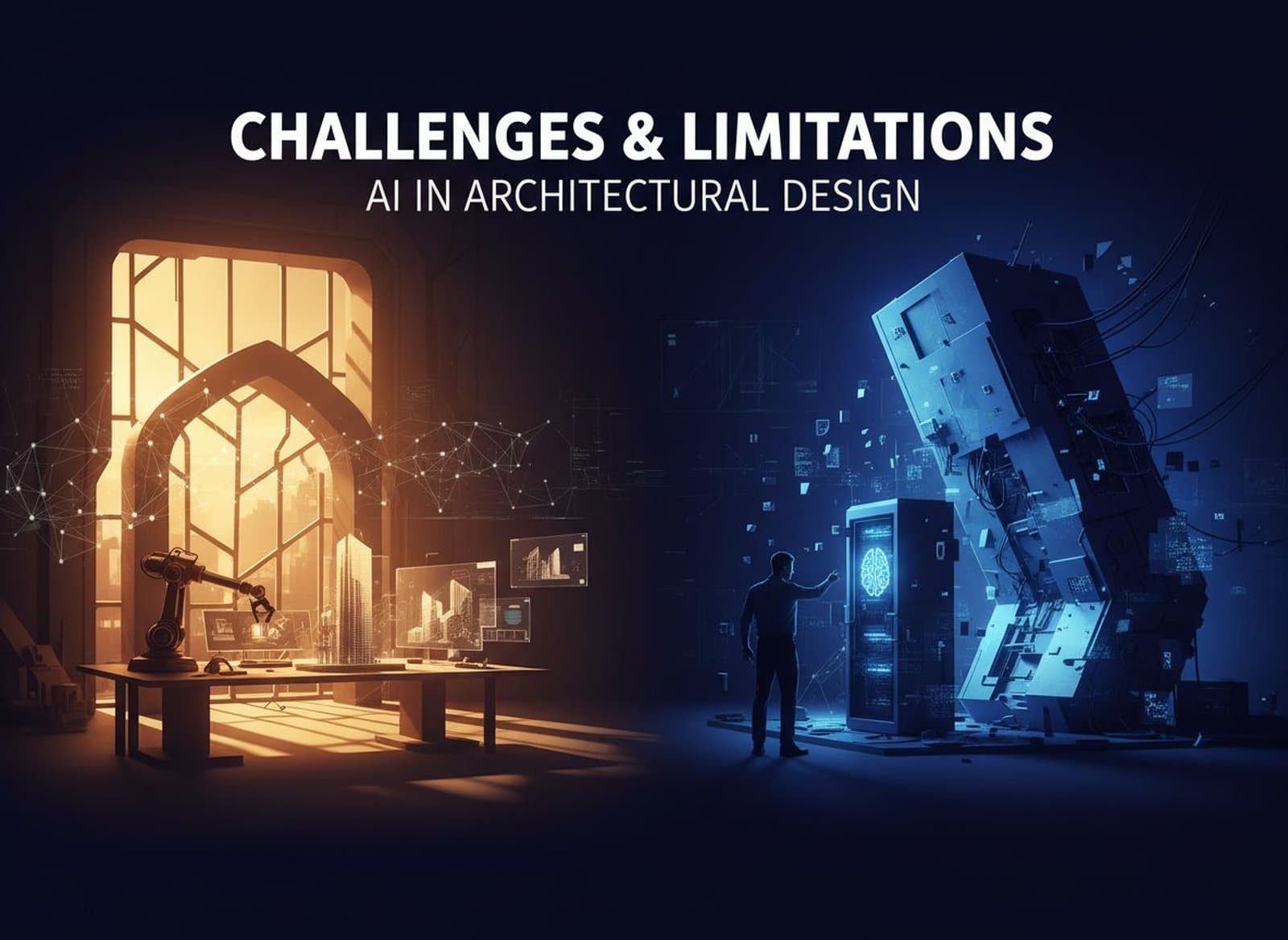
The integration of Artificial Intelligence into architectural design promises unprecedented efficiency and novel creative possibilities. However, beyond the initial excitement, practitioners face significant challenges and limitations of AI in architectural design. This article moves past the hype to address the practical hurdles: the biases baked into AI algorithms, the complexities of integrating AI tools with established software, and the evolving ethical considerations. We explore the real-world limitations that impact workflow, creativity, and the very nature of design authorship, offering a grounded perspective for architects navigating this technological frontier.
Introduction: The AI Promise vs. The Practical Reality
AI, in its various forms-from generative design algorithms to advanced rendering tools and predictive modeling-has begun to redefine what's possible in architecture. The allure is clear: automate repetitive tasks, explore design iterations at scale, and gain data-driven insights. Yet, the path to seamless integration is complex, often encountering friction where theoretical capabilities meet the demands of real-world projects and human-centric design.
The dialogue often focuses on what AI *can* do. This piece, however, shifts the lens to what it *cannot* do, what it *struggles* with, and where its application requires careful human oversight. Understanding these limitations is not a rejection of AI, but a prerequisite for its responsible and effective deployment within the architectural practice.
Data Dependency and Bias: The Foundation's Weaknesses
The bedrock of most AI systems is data. Machine learning models, particularly those employed in generative design, learn patterns, styles, and solutions from vast datasets. If this foundation is flawed, the resulting designs will inherit those flaws.
Algorithmic Bias and its Design Implications
AI models are only as unbiased as the data they are trained on. Historical architectural data often reflects prevailing societal norms, economic disparities, and specific aesthetic preferences of the past. When AI learns from such data, it can perpetuate, or even amplify, existing biases in its outputs. This could manifest as designs that overlook accessibility needs for certain populations, favor specific material palettes that are culturally insensitive, or propose layouts that reinforce existing inequalities in urban planning.
For instance, an AI trained predominantly on designs from affluent urban centers might struggle to generate relevant or equitable solutions for rural communities or developing regions. This risk of perpetuating bias is a significant limitation of AI rendering tools and generative systems, making human review and ethical guidelines indispensable.
The Need for High-Quality, Diverse Datasets
Overcoming algorithmic bias requires meticulously curated, diverse datasets. Collecting and labeling this data is a labor-intensive, expensive process. Architectural projects are highly contextual, meaning a dataset rich in residential designs might be entirely irrelevant for healthcare facilities or industrial complexes.
The proprietary nature of much architectural data, coupled with privacy concerns, further complicates the creation of comprehensive, unbiased training sets. Firms must consider where their AI models are sourcing their 'knowledge' and actively work to diversify that input to avoid producing homogenous or unintentionally discriminatory designs.
Creative Constraints and the "Black Box" Problem
While AI can explore design variations at speeds impossible for humans, its creative process differs fundamentally from that of an architect.
AI's Impact on Human Creativity and Intuition
AI excels at optimizing within defined parameters, but struggles with true conceptual leaps, cultural nuance, or deeply empathetic design. The unique human ability to synthesize disparate ideas, understand emotional responses to space, or interpret abstract client desires remains beyond current AI capabilities. For this reason, AI cannot replace professional architects.
There's a risk that over-reliance on AI could lead to a homogenization of design, where the pursuit of 'optimal' solutions based on predefined metrics stifles radical innovation or artistic expression. The nuanced understanding of a site's history, local community needs, or the client's unspoken aspirations are areas where AI vs. human creativity in design clearly delineates roles. AI is a powerful assistant for exploration, but the driving vision and empathetic understanding still reside with the human designer.
Understanding and Trusting AI Outputs
Many advanced AI models operate as "black boxes." They produce impressive results, but the internal logic or chain of reasoning behind their decisions is often opaque. For architects, this presents a significant challenge: how do you explain a design choice to a client if you don't fully understand why the AI made it? How do you trust a structural recommendation if the underlying computational steps are not transparent?
This lack of explainability, coupled with the potential for subtle errors or illogical configurations, makes rigorous human validation essential. Tools like AI rendering can visualize concepts quickly, but it's the architect's expertise that critically assesses aesthetic quality, functionality, and constructability. What are the main drawbacks of generative AI for designers? This opaqueness is a primary one, demanding designers become expert critics of AI output, not just users.
Integration Hurdles: Interoperability and Workflow Disruption
Integrating new technologies into established workflows is rarely seamless. AI introduces its own set of technical complexities.
Bridging AI Tools with Existing CAD/BIM Software
Architectural practices rely heavily on robust CAD and Building Information Modeling (BIM) software ecosystems. Many AI tools, particularly specialized generative design or analytical platforms, operate in a somewhat isolated manner. Ensuring seamless data exchange and interoperability between these disparate systems is a major technical constraint.
Proprietary file formats, inconsistent APIs, and varying data schemas often necessitate complex workarounds, manual data entry, or custom scripting-all of which consume time and resources. For example, using an AI architecture generator for initial concepts then requires careful translation of that data into a firm's BIM environment for detailed development. This challenge is a key part of the technical constraints of generative design and overall AI adoption.
Training and Upskilling the Design Team
Implementing AI isn't just about buying software; it's about investing in people. Architects and designers need new skills to effectively utilize, manage, and critically evaluate AI outputs. This includes understanding prompt engineering for generative AI, interpreting data visualizations from analytical AI, and developing a critical eye for potential biases or errors.
The cost and time associated with training existing staff, or hiring new talent with AI expertise, can be substantial. Firms must navigate this transition without disrupting ongoing projects, fostering a culture of continuous learning that embraces technological evolution rather than resisting it.
Cost and Scalability: The Investment Reality
The initial and ongoing financial commitment associated with AI integration is a practical consideration for any architectural firm.
Initial Investment and Ongoing Maintenance
Implementing AI tools often requires significant upfront investment. This includes licenses for specialized software, potentially upgrading hardware (e.g., high-performance GPUs for local AI processing), and setting up robust data storage and management systems. Furthermore, many advanced AI models require ongoing cloud computing resources, which can incur recurring subscription fees.
For smaller firms, in particular, this initial outlay can be prohibitive. A detailed cost-benefit analysis is crucial to justify the investment and project a clear return on investment (ROI).
Scaling AI Solutions Across Projects
Beyond initial setup, scaling AI solutions across multiple projects and diverse client needs presents its own challenges. What works for a conceptual massing study might not be suitable for detailed interior design or building performance analysis. Maintaining, updating, and adapting AI models for new contexts requires continuous effort.
Moreover, if AI systems become too specialized or siloed, they can complicate rather than streamline overall firm operations. The goal is scalable, adaptable AI tools that enhance various stages of the design process without introducing new bottlenecks.
Ethical and Legal Labyrinths
The rapid advancement of AI has outpaced the development of clear ethical guidelines and legal frameworks, creating ambiguity for architects.
Intellectual Property and Ownership of AI Designs
A critical question is: who owns the intellectual property (IP) of a design generated or heavily influenced by AI? If an architect uses an AI tool to generate a unique facade, does the IP belong to the architect, the AI developer, or is it uncopyrightable? Current copyright laws were written for human authorship, and the application to AI-generated works is an evolving legal debate.
This ambiguity creates risks for firms and clients alike, potentially impacting contractual agreements and the commercialization of designs. Clearer legal precedents are urgently needed to define ownership and usage rights for AI-assisted architectural creations.
Accountability and Liability in AI-Assisted Design
If an AI-generated structural model contains a critical flaw that leads to failure, or if an AI-optimized ventilation system results in poor indoor air quality, who is liable? The architect? The software developer? The data provider? This is a core part of understanding what are the risks of using AI in architecture?
Currently, the architect-of-record typically holds ultimate responsibility for the safety, integrity, and compliance of a building. This means architects must exercise diligent oversight, critically review all AI outputs, and be prepared to take full accountability. While AI can assist with aspects like building code compliance AI (by referencing regulations), the final interpretation and assurance of compliance rest with the human professional. Ensuring structural integrity and AI models are verified by human engineers is non-negotiable.
Navigating the Future: Strategies for Successful AI Integration
Acknowledging these challenges is the first step toward building resilient and effective AI integration strategies.
Firms should adopt a phased approach, starting with pilot projects to understand AI's capabilities and limitations in their specific context. Prioritizing AI tools that address clearly defined pain points and provide measurable value will yield the best results. Investing in continuous education for staff is paramount, transforming architects into 'AI-fluent' designers rather than passive users. This helps to mitigate AI errors in architectural projects by empowering human oversight.
Establishing internal ethical guidelines for AI use, particularly concerning data privacy, bias detection, and transparency, is also crucial. Architects must remain at the center of the design process, leveraging AI as an intelligent co-pilot while retaining ultimate creative direction and ethical judgment.
Conclusion: A Balanced Approach to AI in Architecture
The journey of integrating AI into architectural design is not without its significant challenges and limitations. From mitigating data bias and navigating the "black box" of creative AI to overcoming interoperability hurdles and resolving complex ethical dilemmas, architects must approach this technology with a pragmatic and critical mindset.
AI offers immense potential for efficiency and innovation, but it is a tool that requires human intelligence, intuition, and oversight to be truly effective. The future of architecture, therefore, lies not in replacing the architect with AI, but in forging a powerful partnership where the strengths of both are leveraged to create more thoughtful, sustainable, and human-centric built environments.
Trending
Challenges and Limitations of Integrating AI into Architectural Design
7 Best Styldod Alternatives & Competitors in 2026: Full Review
The Next Gen of Smart Sales: Integrating Lighting Catalogs with Agentic AI and Paintit.ai
Looking for HomeByMe Alternatives? Top AI Tools for Instant 3D Design & Rendering
Best AI Bathroom Design App: Visualize Your Sanctuary in Seconds
Related articles

7 min read
Best AI for Furniture Design: The Ultimate 2026 Pro Guide
Discover the best AI for furniture design in 2026. Compare Paintit.ai, Planner 5D, and more to optimize your 3D modeling, ideation, and sustainable workflows
Yulii Cherevko
CEO paintit.ai
7 min read
Challenges and Limitations of Integrating AI into Architectural Design
Explore the limitations of AI in architecture: from algorithmic bias and the 'black box' problem to BIM integration hurdles and evolving ethical legal risks
Yulii Cherevko
CEO paintit.ai

8 min read
7 Best Styldod Alternatives & Competitors in 2026: Full Review
Discover the top Styldod alternatives for AI virtual staging in 2026. Compare Paintit.ai, Collov, and more to find the best tool for photorealistic property design
Yulii Cherevko
CEO paintit.ai

5 min read
The Next Gen of Smart Sales: Integrating Lighting Catalogs with Agentic AI and Paintit.ai
Discover how Agentic AI and Paintit.ai transform lighting sales. Enhance personalization, reduce returns, and automate catalogs for the next gen of retail.
Yulii Cherevko
CEO paintit.ai
8 min read
Looking for HomeByMe Alternatives? Top AI Tools for Instant 3D Design & Rendering
Searching for a HomeByMe alternative? Explore the best AI-powered tools for instant interior design and photorealistic rendering. Find your perfect fit with Paintit.ai.
Yulii Cherevko
CEO paintit.ai