14 min. reading

Yulii Cherevko
CEO paintit.ai
Published: Updated:

The best RoomGPT alternatives solve different parts of a redesign. A quick style preview, a follow-up request to change the sofa, and a furnished listing photo are different jobs. Compare Paintit.ai, Decoratly, Spacely AI, MyRoomDesigner.AI and REimagineHome by those jobs before paying for more images.
If RoomGPT already gives you a useful first idea, you may not need to replace it. Switching makes more sense when you need a specific edit, image references, a different payment model or a workflow for repeated projects. None of these photo tools should be treated as a measured floor plan.
This 2027 edition uses published product information reviewed on November 4, 2026, with older offers dated separately where current information could not be confirmed. Prices reflect the stated offers, not promised 2027 rates. This is a workflow comparison, not a controlled quality or speed test. Paintit.ai publishes this guide and is included.
| Tool | Choose It For | Free Starting Point | Main Limit to Check |
|---|---|---|---|
| Paintit.ai | Room-photo concepts, conversational changes and reference images | Credits after registration | Model costs and plan access; no measured plan or exact-product guarantee |
| Decoratly | Style exploration followed by paid photo edits | One watermarked design in eligible countries on the checked pricing offer | Editing access, pass allowance and current checkout offer |
| Spacely AI | Image-based rendering and staging workflows | 40 trial credits on the checked offer | Personal $25/month or $240/year; Studio $50/month or $480/year; check features and license by plan |
| MyRoomDesigner.AI | Photo redesign plus a Design Studio and shopping-list tools | 1 room project, 3 style explorations and 1 before/after export per month | Designer Starter $29/month or $288/year; redesign and exploration allowances differ |
| REimagineHome | Photo redesign, conceptual staging and product-guided iterations | Five free designs for new users | Product discovery, references and image quality vary by plan |
RoomGPT competitors are worth comparing when a style preview leaves you with another job to do, such as revising one item or preparing several views of a property. Choose for that next edit rather than assuming every room-image tool gives you the same controls.
RoomGPT takes a room photo and produces a new visual direction. That can be enough if you only want to find out whether you prefer a modern, coastal or more traditional room. A limited tool can be useful when the decision itself is small.
RoomGPT advertises one free generation after Google sign-in on its public design-access page. Its fulfillment policy describes one-time credit purchases rather than a recurring subscription. Paid pack prices were not verified for this edition; check the pack amount and download conditions before buying.
A reason to look at alternatives to RoomGPT is the need to revise an accepted idea without starting the whole room again. Write down the missing action first: keep the flooring, use a fabric reference, remove one object or prepare a clean image for a client. A longer feature list is not much help if that particular action is unavailable.

Paintit.ai lets you work from a room photo and continue the design through a conversation. You can describe what should change, add an image reference for a material or style, and review the next version against the original. It is a useful choice when the first room concept is close but the finish, furniture direction or color still needs work.
The distinction between the main room image and a reference matters. Your room photo supplies the space being edited; a reference can supply selected cues such as a wood finish, upholstery or palette. Specify which cue you want to borrow. Otherwise, a strong reference may influence more of the scene than you intended.
For a first concept, the room-photo redesign workflow keeps the task tied to an existing space. It does not require rebuilding the room as an editable 3D model.
Paintit also includes paint-color catalogs from Behr, Benjamin Moore, Dulux, Nippon Paint and Sherwin-Williams, with brand filters and search by name, code or HEX. Those references help narrow a color decision; they do not replace testing a physical sample in your room.
Access: The public offer reviewed on November 4, 2026 displayed Starter at $14.99 per month for 500 credits and Pro at $29.99 for 1,500. These were discounted displayed offers, not guaranteed renewal prices. Pro includes a commercial usage license; do not assume the same permission on every tier. Free credits require registration, and credits are not a count of finished designs.
Trade-off: A generated image may change details you wanted to keep. Review windows, built-ins, room proportions and furniture shapes. Do not use it as a construction drawing or a guarantee that an exact product will appear unchanged.

Decoratly combines a broad room redesign with more selective editing tools. Its published paid features include changing wall colors, adding or removing objects, lighting edits, design chat and a reference-based clone workflow. That makes it worth comparing when a style-only result leaves too much to fix.
The public page offers one watermarked design with six starter styles in eligible countries, including the United States and United Kingdom. The public offer displayed $14.99 for a non-renewing 30-day pass with 200 designs; another public offer showed $9.99. Confirm the amount in the app before buying. Paid edit tools are not part of that one free design.
Choose it when: You want to explore a style, then decide whether paying for edit tools is worthwhile for a short home project.
Trade-off: Free access does not include every editing feature. A visually convincing output still needs a room-by-room check; it is not evidence of measured geometry or a particular percentage of accuracy.

Spacely AI is a RoomGPT alternative to consider when your work involves image-based rendering or staging rather than a single style experiment. Compare the workflow that matches your starting image and the amount of revision work you expect to do.
The checked pricing page offers 40 trial credits. Treat that as a trial allowance, not unlimited free designs or a promise of 40 finished images. Different operations can consume credits differently, and the image you deliver may need another edit or an upscale.
For client work, confirm the commercial license, watermark removal and download rights on the exact plan you select. Current permissions still need confirmation. The public offer reviewed places integrations and Pro rendering features on Studio; do not assume Personal includes that workflow.
Choose it when: You need to compare a rendering-oriented workspace for repeated design presentations.
Trade-off: A larger subscription allowance is only useful if it covers your actual workflow and license needs. Test a representative image before committing a portfolio of projects.
Personal lists $25 per month or $240 billed yearly with 500 monthly credits; Studio lists $50 monthly or $480 yearly with 1,500. The introductory allowance is 40 trial credits, not 40 guaranteed finished images. Studio is the tier to check for software integrations and Pro tools. Confirm commercial-use permission and watermark conditions for the exact plan before client work.

MyRoomDesigner.AI combines photo-based room concepts with chat-based changes. Its public interface also accepts optional product images. A separate Design Studio offers a shopping-list creator, background removal, importing favorites and finding similar products.
This is a useful distinction if your next task is organizing possible purchases rather than generating another room style. A shopping list lets you collect candidate items. It does not, by itself, establish that every object in a generated room is an exact, available product.
Choose it when: You want a visual concept and a workspace for assembling a product shortlist.
Price and allowance: Designer Starter lists $29 monthly or $288 billed annually, with 50 room redesigns and 200 style explorations per month. Free includes one room project, three style explorations and one before/after export per month. These are different units, not interchangeable generation credits. Verify dimensions, stock and delivery directly with the retailer.
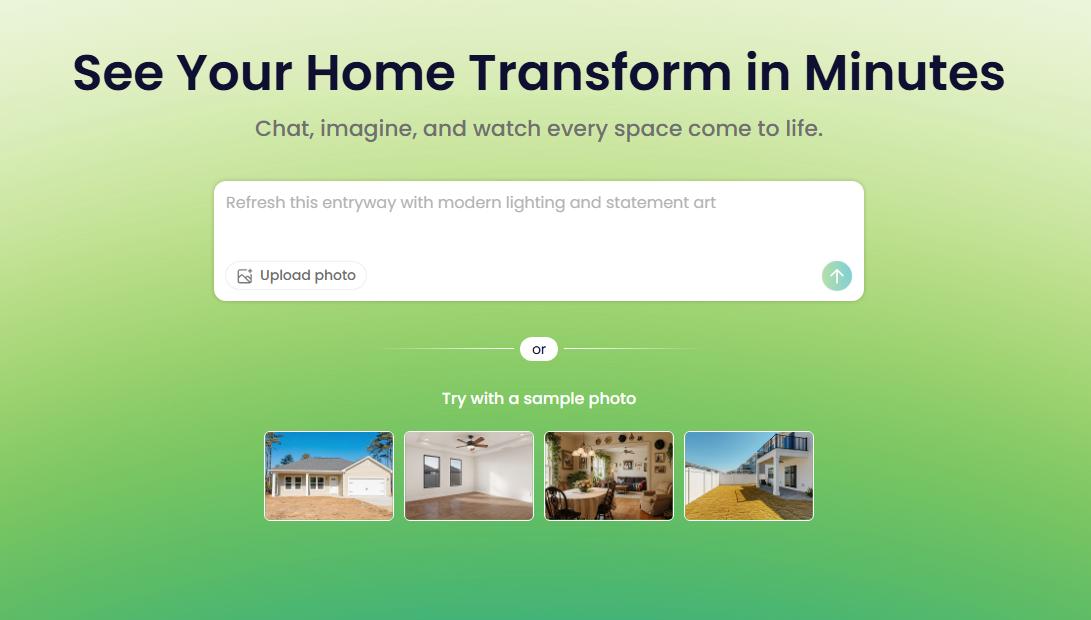
REimagineHome supports room-photo redesign and staging. Its higher plans add features such as chat-based iterations, reference guidance and product discovery. It is relevant when you want to compare a furnished concept with possible real-product directions.
New users are offered five free designs. The checked Essential plan costs $19 per month for 30 credits; Pro costs $36 for 200. A visualization-only generation uses one credit, while a visualization with product discovery uses two. Product discovery and reference features are not included in every plan.
Choose it when: You need photo redesign or staging and want to evaluate product-guided work on an eligible plan.
Trade-off: Product discovery does not remove the need to verify dimensions or availability. For a listing, compare the result with the original photograph and reject changes to permanent features or concealed defects.
A free RoomGPT alternative is useful for testing the workflow, but the allowance must cover what you want to test. One image may answer a style question. It cannot demonstrate how a product handles five rounds of revision, a watermark-free download or a commercial presentation.
Among these options, Paintit offers credits after registration, Decoratly offers one free design in eligible countries, Spacely offers 40 trial credits and REimagineHome offers five introductory designs. MyRoomDesigner.AI includes one room project, three style explorations and one before/after export per month on Free. Those are limited allowances, not unlimited free use.
For paid work, compare these four costs together:
Calculate cost per usable image only after counting rejected outputs and necessary edits. For example, a package that produces ten images may leave you with only two that preserve the room correctly. Divide the amount actually spent by those two usable results, not by the advertised allowance.
A room with a visible window, doorway and fixed storage is a better comparison subject than a blank wall. Those details make unintended changes easy to spot. Use the same source photo across the tools you are considering.
Start with a modest brief: change the wall color to a muted green; keep the oak floor, white window frame and existing sofa. A full makeover changes too many variables to show whether a specific control works. Keep a copy of the original image next to each output.
If the result keeps altering the room, our guide to getting more realistic AI interior images explains how to make the input and brief easier to interpret.
Count windows and doors. Follow the edges of cabinetry and built-ins. Check whether the room became wider, the ceiling rose or the floor pattern changed. Then inspect furniture: a sofa that looks attractive but blocks the doorway is not a useful recommendation.
Keep these observations as separate notes rather than combining them into an unexplained score. A tool may handle your bedroom well and struggle with a kitchen full of reflective surfaces. That is a reason to test the room you actually need to change.
Ask for a warmer wall shade or a different upholstery while keeping the rest of the accepted concept. Compare the new result with both the previous version and the original. This is where you find out whether the workflow supports refinement or keeps replacing the entire design.
For paint decisions, a preview using named paint colors can help narrow the shortlist. Check the final choices with physical samples under daytime and evening light; the screen is not a calibrated sample of the coating.
Open the downloaded file, not just the on-screen preview. Look for a watermark, softened details, warped handles and inconsistent shadows. Record what you spent on the initial generation, the follow-up edit and any upscale. This gives you a comparison tied to one finished task.
A useful RoomGPT alternative should support the change you could not finish in the first workflow. Keep the same original photo, accept one design direction, then ask for a different fabric on the chair without changing the windows or flooring. Save both results so you can see whether the second step repaired the brief or replaced it.
Record the cost of that whole sequence: first output, rejected attempt, correction and download. A 200-design pass and a 500-credit subscription cannot be compared by their advertised numbers alone. If the tool consumes different credits for edits or higher-quality output, the finished task is the meaningful unit.
Also check what happens after the paid period ends. A retained image is not necessarily a retained editing workspace. Download the accepted concept and keep your original photo, brief and product references separately.
A product's image quality does not establish its privacy or security. Before uploading a room photo to RoomGPT or an alternative, read the current privacy policy and check retention, deletion, sharing and any use of uploads to improve models. Do not assume that paying for a plan makes every project private.
Crop out paperwork, family photographs, house numbers and anything that identifies someone unnecessarily. For client work, confirm that you have permission to upload the photograph and that the service's terms fit your agreement. Use a non-sensitive image if you cannot establish how uploads will be handled.
The FTC's guidance on app permissions recommends reviewing access to photos and other device information and turning off permissions an app does not need. Those checks are useful across room-design tools; they are not a security certification for any one provider.
Choose by the task and the limit. Paintit.ai provides credits after registration, Decoratly has a limited free design in eligible countries, Spacely AI uses trial credits and REimagineHome offers five introductory designs. Check editing access and download conditions as well as the number of images. These are limited starting offers, not unlimited free design services.
You can request that furniture stays and use available image or item controls, but you still need to inspect the result. Check the silhouette, dimensions, fabric and position against the original. A similar-looking sofa or chair is not necessarily the exact product you own. Do not order a replacement based on generated proportions.
It solves a different problem. Photo tools help you compare visual changes; a floor planner lets you work with dimensions and an editable layout. If you need to check whether a table fits or a doorway clears, compare options for editable room planning and take real measurements. A realistic-looking image is not a dimensioned plan.
Check the selected plan's commercial-use terms and the rules of your listing service. Keep the original photo and clearly identify virtual staging where required. A photo-based virtual staging workflow can help illustrate furnishing ideas, but reject outputs that hide damage, alter permanent features or misrepresent the available space.
Choose Paintit.ai for a room-photo conversation and reference-guided changes, Decoratly for its style-and-edit approach, Spacely AI for a rendering-oriented workflow, MyRoomDesigner.AI for concept-to-shopping-list work, or REimagineHome for redesign and staging with plan-dependent product guidance.
Before committing, use one room and one specific change. Keep the tool that gives you an understandable path from the first image to a usable result, with costs and permissions you can verify.