7 min. reading

Yulii Cherevko
CEO paintit.ai
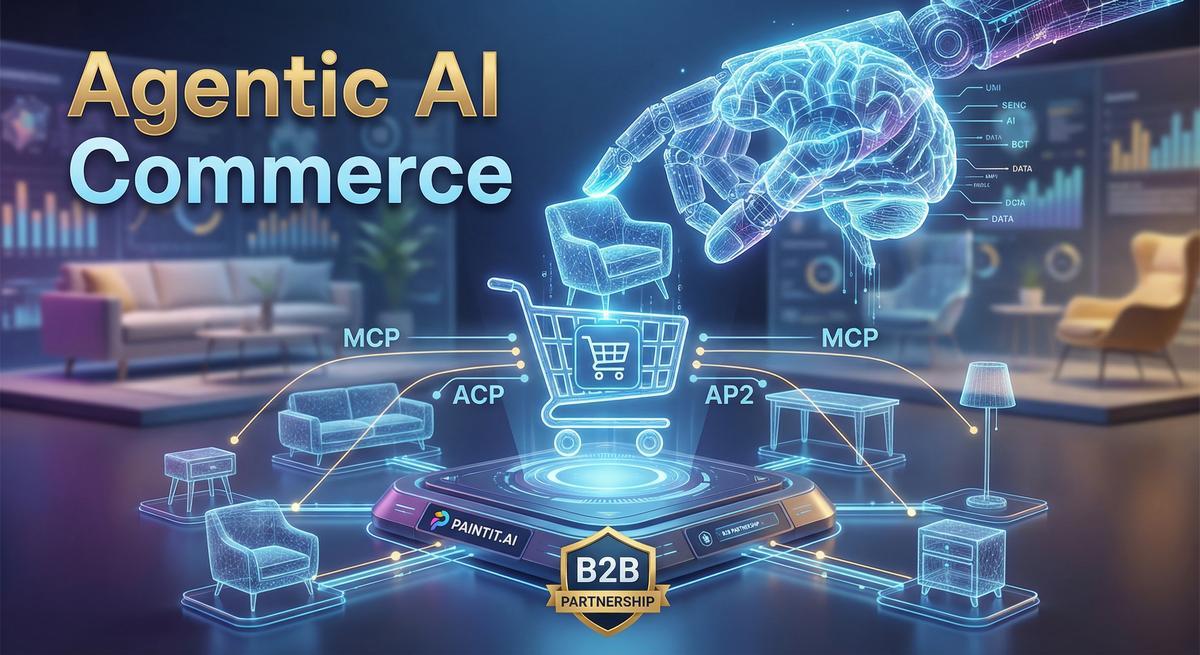
The digital landscape is shifting beneath our feet. We are moving from an era of contemplation to an era of action. For the last two decades, e-commerce has been defined by the "search and click" model. Humans bore the cognitive load: searching, filtering, comparing dimensions, and checking compatibility. But today, we are witnessing the dawn of Agentic AI Commerce-a seismic shift that McKinsey and Boston Consulting Group identify as the third tectonic wave in digital trade.
This is not just another buzzword. It is the transition from Generative AI, which offers advice, to autonomous systems capable of executing actions. The "Zero-Click Commerce" era is upon us. In this new reality, the customer interaction model changes fundamentally. The user expresses an intent-"furnish my living room in a Scandinavian style for under $2,000"-and the AI agent takes over the execution, orchestrating search, negotiation, and logistics.
For furniture brands and retailers, this presents a critical strategic imperative. Between 2025 and 2027, a "window of opportunity" exists. If your store is not "understandable" to these AI agents, you risk becoming invisible to the next generation of high-value buyers. In this article, we will explore the technical infrastructure-from MCP to ACP protocols-required to integrate your brand into the Paintit.ai ecosystem and secure your place in the future of commerce.
The traditional sales funnel is collapsing. In the standard e-commerce model 1.0 (Web) and 2.0 (Mobile), success was driven by catalog availability and user convenience. The primary metrics were traffic and session conversion. However, as AI becomes the primary interface for information, the "top of the funnel" is disappearing. Search engines are being replaced by direct answers from Large Language Models (LLMs).
The economic potential here is colossal. Analysts forecast that by 2030, the global market for agentic commerce could reach between $3 trillion and $5 trillion. In the United States alone, B2C agents are expected to orchestrate up to $1 trillion in spending.
We are rapidly approaching a tipping point. By 2027, it is predicted that approximately 50% of all transactions in advanced digital ecosystems will be initiated or supported by Artificial Intelligence. For furniture retailers, this is not a distant future; it is an immediate operational challenge. Brands that fail to adapt their data and processes for agent interaction face the phenomenon of "invisibility"-their products will simply not appear in the selection sets of the algorithms that will soon become the internet's biggest spenders.
The new model is an "intent-driven flow". Unlike human shoppers who browse visually, agents shop based on strict parameters and data validation. They do not care about marketing fluff; they care about structured facts, availability, and specific attributes. Integrating now allows you to capture this demand at its source.
At Paintit.ai, we position our platform as the solution to the industry's "Last Mile" problem. The interior design market is flooded with generative tools that create stunning visualizations but leave the user trapped in a "Visualization Trap". A user gets a picture of a perfect room but has no way to buy the items in it.
We are moving the industry from the "Advise" phase to the "Act" phase. Our core innovation is the "Realize Project" concept. When a user (or a designer using our tools) clicks this button, it activates a network of autonomous agents. These agents deconstruct the visual image into specific Stock Keeping Units (SKUs) from the real catalogs of our connected partners.
For a furniture brand, integrating with us transforms you from a passive catalog entry into an active node in an agentic network. The process follows a sophisticated pipeline:
Semantic Analysis: Our Orchestration Agent analyzes the user's project. It doesn't just see "a grey sofa." It identifies functional requirements: "grey sofa, width under 220 cm, anti-claw fabric, budget under $1500".
Orchestration: The system sends inquiries to connected Brand Agents via API, querying PIM/ERP systems directly.
Dynamic Proposal: Your brand agent returns a contextualized offer-current price, exact delivery timeline for the specific location, and confirmed stock status.
Visual Verification: Using our AI Rendering technology, we replace the generative placeholder with a precise 3D model of your actual product, allowing the user to see exactly what they are buying.
This integration offers benefits that traditional marketplaces cannot match:
Lower Returns: By using precise 3D models and AR, clients "try" furniture in their space before buying, drastically reducing return rates.
Access to Professionals: You gain direct access to high-margin B2B orders from interior designers and real estate agents using our commercial staging tools.
Sales Automation: Agents handle routine questions about availability and specs, freeing your team for strategic tasks.
To sell to agents, you must speak their language. In the 2025-2027 timeline, a new three-tier stack of protocols is emerging to ensure interoperability. These are not just "nice-to-haves"; they are the foundation of the new digital economy.
Large Language Models (LLMs) have a fundamental flaw: they are isolated from real-time data. They don't know that you updated the price of your flagship armchair five minutes ago.
What it is: The Model Context Protocol (MCP) acts as a universal interface-think of it as a "USB-C for AI applications". How it works:
MCP Server: This is what you, the furniture brand, need to deploy. It acts as a gateway to your internal systems (PIM, ERP, databases).
Resources: It exposes passive data like your product catalog and assembly instructions.
Tools: It enables active functions, such as "Check Stock by SKU" or "Calculate Shipping to Zip Code".
Implementing an MCP server means that any authorized agent (from Paintit, Amazon, or Google) can instantly read your live data without relying on outdated web scraping.
While MCP connects agents to data, the Agent Communication Protocol (ACP) connects agents to other agents. In complex B2B scenarios, a single query isn't enough-cooperation is required.
What it is: ACP is the "language of negotiation." It allows agents built on different stacks (LangChain, AutoGen, BeeAI) to understand each other. Key Features:
Asynchronous Communication: Furniture production takes time. ACP allows an agent to send a "Task: Order Production" request and handle a "Ready" response a week later without losing context.
Negotiation: If a requested delivery slot is unavailable, your logistics agent can use ACP to counter-offer: "Tomorrow is impossible, but we can deliver the day after with a 5% discount".
The biggest barrier to autonomous commerce is trust. Businesses fear AI "hallucinations" leading to financial errors. The Agent Payments Protocol (AP2), supported by giants like Google and Mastercard, solves this.
What it is: A standard for secure, verifiable AI transactions. Core Mechanism:
Verifiable Intent: An agent cannot spend money arbitrarily. It acts based on a cryptographically signed "Intent Mandate"-a digital contract where the user pre-defines parameters (e.g., "Buy this table only if the price is under $500").
Cart Mandate: When the right product is found, the agent creates a signed "Cart Mandate" that locks in the price and item list for the transaction.
SEO (Search Engine Optimization) was about ranking links for humans. In the agentic era, this strategy is losing effectiveness. It is being replaced by Generative Experience Optimization (GXO), also known as Answer Engine Optimization (AEO).
The goal of GXO is to provide data with such structure and authority that an AI model selects your product as the "best answer" to a user's need. Agents prefer content that is factually dense (dimensions, weight, materials) rather than marketing-heavy descriptions ("stylish," "wonderful").
To succeed with GXO and Paintit.ai, your data must be machine-readable.
1. Schema.org and JSON-LD Basic product markup is no longer enough. You need specific furniture extensions:
Dimensions: Use quantitativeValue for width, height, and depth. If an agent doesn't know if a sofa fits through a door, it will mark the purchase as "risky" and avoid it.
Assembly: The assemblyRequired (Boolean) field is crucial. Agents need to warn users about installation complexity.
Inventory: Dynamic statuses like InStock, PreOrder, or BackOrder must be exposed via the availability property.
2. 3D Model Standards Since Paintit.ai is visual-first, 3D assets are critical.
Formats: The industry standards are GLB (for web/Android) and USDZ (for Apple AR).
Quality: Models must be Low Poly for speed but use PBR materials for realism. Crucially, real physical dimensions must be embedded in the file metadata for accurate 1:1 AR scaling.
To become a fully integrated partner in the Paintit.ai ecosystem, your business needs to pass the "Agent-Readiness Checklist." This is a practical guide for CTOs and E-commerce Directors.
Ensure your data is clean and structured. An agent cannot "guess." It needs precise attributes for every SKU. If your data is trapped in PDFs or unstructured text descriptions, it is invisible to the agent economy.
Move beyond flat file feeds. Develop APIs with Open Specification (OpenAPI) that allow agents to query your stock in real-time. Implement webhooks to notify our system immediately when stock levels change.
Prepare your technical infrastructure for automated negotiations. This involves setting up systems that can handle asynchronous requests and counter-offers from external agents without human intervention.
Agents need to know the rules of engagement before they buy. You must implement standardized "Policy Cards".
MerchantReturnPolicy: Define returnFees, returnWindow, and restockingFee in your code. An agent tasked with finding a "risk-free purchase" will filter out products lacking clear return data.
Create a testing environment. Before unleashing autonomous agents on your live inventory, establish a "Sandbox" environment. This allows us to test the integration, verify the MCP server responses, and ensure that the "Intent Mandates" are executing correctly.
The transformation of e-commerce by Agentic AI is irreversible. We are witnessing the end of the "search" era and the beginning of the "execution" era. For furniture brands, the question is not if agents will become a primary sales channel, but when you will be ready to serve them.
Success in 2025-2027 will not be defined by the prettiest website banner, but by the quality and accessibility of your structured data. Brands that implement MCP and ACP protocols, invest in high-quality 3D assets, and embrace GXO strategies will become the default choice for the new economy. Those who ignore these changes risk digital obsolescence.
Paintit.ai transforms design projects into real purchases. Do you want your products to automatically end up in the shopping carts of AI agents?
Yulii Cherevko
CEO paintit.ai