9 min. reading

Yulii Cherevko
CEO paintit.ai
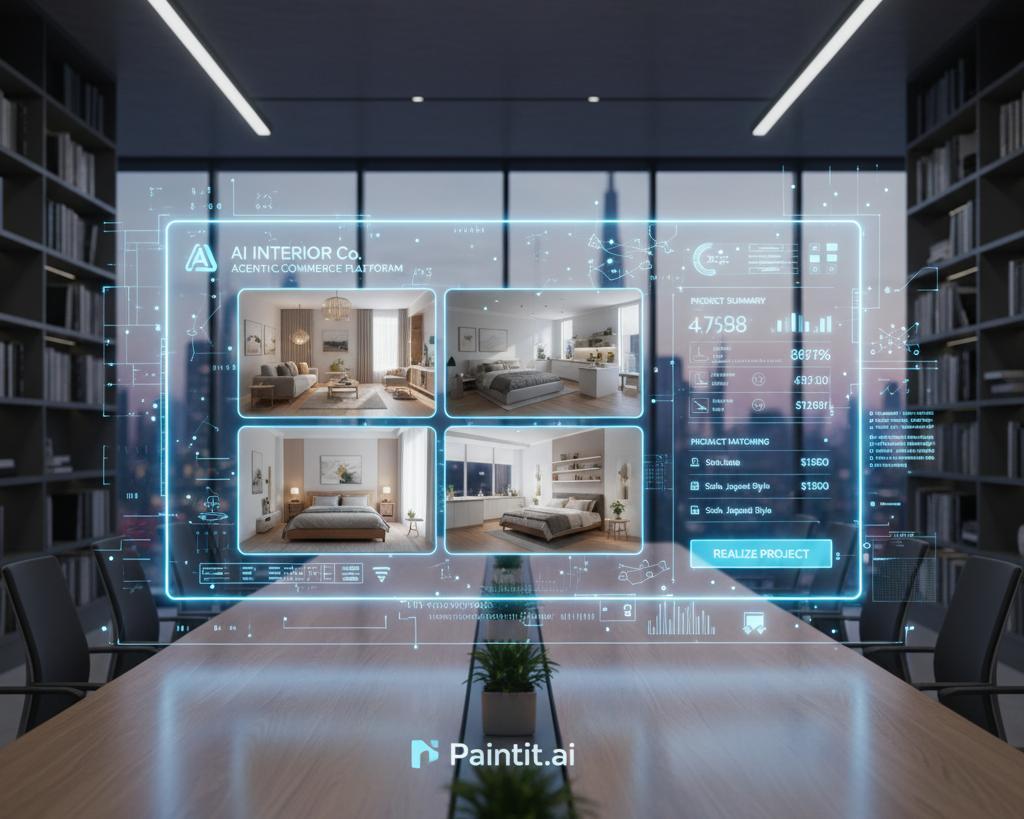
Subtitle: How autonomous agents are taking us from "mood board" to "project realized" in one click, transforming the $520 billion furniture market.
The key thesis for the new era of commerce was defined by Bill Gates: "Agents won't just give you recommendations; they will help you act on them." This single quote outlines the "Age of AI" that Gates himself proclaimed, and it draws a clear line between the AI we have (Generative AI, which advises) and the AI that is emerging (Agentic AI, which acts).
This is not a simple iterative update. After the first revolution (e-commerce) and the second (mobile commerce), Agentic AI represents the "third great shift in commerce." Analysts at McKinsey describe it as a "seismic shift in the market." It's a "reimagining of shopping itself," where the entire e-commerce model we've spent 20 years optimizing is about to be "completely disrupted."
The perfect, tangible example is interior design. This industry is already being transformed by Generative AI for visualization. However, it remains fragmented, leaving the user with a beautiful picture but a logistical nightmare to implement it. Agentic AI is here to solve that "last mile" problem.
This report will define Agentic AI Commerce, contrast the old "search-and-click funnel" with the new "intent-driven flow," and use the practical example of Paintit.ai's "Realize Project" concept to break down how this technology is revolutionizing the interior design industry for both consumers (B2C) and businesses (B2B).
This section aims to establish the fundamental concept, directly addressing the core thesis: "This is not just a chatbot."
Definition: Agentic AI Commerce is an autonomous AI system that acts on behalf of a user or business to accomplish a specific, complex goal with minimal human intervention. In commerce, it creates an "intelligent and autonomous shopping ecosystem."
It's crucial to clarify the hierarchy. Predictive AI forecasts. Generative AI creates. But Agentic AI acts, executes, and completes tasks. It is the action layer built on top of the other two.
The "Advise" Role (Conversational AI):
Traditional chatbots and Generative AI are "reactive." They "optimize communication" by answering questions, drafting emails, or summarizing text. They are tools we use, much like a "smart calculator." In e-commerce, they might guide you to a product page.
The "Act" Role (Agentic AI):
Agentic AI is "proactive." It "manages execution." This is a partner we collaborate with. It can "plan, set goals, adapt to its environment, and act autonomously." It doesn't just find a product; it executes the entire sequence: it compares, negotiates, and purchases.
To explain how an agent can "act" while a chatbot cannot, we use a clear framework.
Memory: The agent "can remember user preferences, sizes, and past purchases." This is the context layer.
Reasoning: This is the "brain." It "can break down a complex query into structured, actionable steps." It doesn't just answer; it plans.
Tools: These are the "hands." Agents "have access to APIs and external databases, allowing them to find new information and take action." This is the most critical part: the ability to connect to external systems to read reviews, check inventory, and, crucially, transact.
A real-world example is Mastercard's "Agent Pay" technology, a financial mechanism allowing a "verified, 'shopping AI agent' to transact on behalf of consumers."
This ability to reason and use tools means an agent isn't a monolith that "knows everything." It is an orchestrator. Its intelligence lies less in possessing information and more in its ability to connect diverse systems and tools. The reasoning engine is essentially a workflow planner. The true leap from chatbot to agent is the leap from being an "answerer" in one silo to an "orchestrator" of many systems.
This section analyzes the profound break from the traditional customer journey.
The traditional e-commerce conversion funnel (Awareness, Consideration, Conversion) is a high-friction, user-driven process. Google describes it this way: "A consumer sees a product on social media, searches for it on a marketplace, reads reviews on a third-party site, and finally, makes a purchase."
This process is "disjointed" and requires "work." The user must manually bridge the gaps between platforms, synthesizing data from dozens of open tabs.
Agentic AI inverts this model. The user no longer travels through the funnel. The user states their intent at the top, and the agent executes the entire funnel on their behalf.
We are entering what McKinsey terms an "integrated, intent-driven flow." This is a "fundamental shift toward high-context, conversational discovery." The new customer journey becomes simple: "query $\rightarrow$ discovery $\rightarrow$ transaction." The agent, not the user, "will increasingly own the discovery process."
Example:
Old Funnel: "I need a new armchair." $\rightarrow$ 10 hours of Googling, filtering, comparing, reading reviews, checking shipping.
New Flow: "Find me an armchair that matches my Japandi-style sofa, is pet-friendly, and costs under $500." The agent performs the 10 hours of work and returns with 3 options, or even just one completed purchase.
This change has profound implications. Sources indicate "the top of the funnel is collapsing." AI answer engines are "resolving informational queries" before users ever hit a website. This means metrics like "traffic, impressions, and clicks will matter less when an AI agent stands between the shopper and the brand."
Consequently, traditional marketing (SEO, ad spend) aimed at capturing browsers is becoming obsolete. A new concept is emerging: "generative experience optimization (GXO)" or the demand for "agent-ready commerce design." The goal for a business is no longer to be #1 on Google for "Japandi rug." The goal is to be the #1 product chosen by the agent.
This is the core of the report, using the Paintit.ai example to make the abstract revolution concrete.
First, we must assess the current state of generative AI in design. Tools like IKEA Kreativ, InteriorAI, and Fulhaus are revolutionary in their own right. They allow users to upload a photo and instantly generate "photorealistic design concepts." Our own AI virtual staging tool excels at this, transforming empty rooms and allowing agents to "personalize furniture layouts."
The Limitation: This is the "Visualization Trap." These tools brilliantly advise. They create a "mood board" or a list of item types (e.g., "brown leather sofa"), but they do not execute. The user is still left with 10 hours of work to find and purchase those items.
Now, we introduce the hypothetical "Realize Project" button within the Paintit.ai room designer.
The Scenario: A user has just finished designing their perfect living room. Instead of a "list of items," they click "Realize Project."
The Intent (Query): 'Find this exact sofa, two similar armchairs, and the Japandi rug, with a budget of $3,000.'
We must deconstruct what's happening. This button doesn't trigger one AI; it triggers a team of specialized agents.
Step 1: The Coordinator Agent receives the request. Using "Reasoning" and a "planning template," it breaks the complex task into a "sequential pipeline."
Step 2: The Visual Assessor Agent scans the 3D model. It uses visual search to identify the exact sofa and semantic search to understand the style ("Japandi") and the concept of "similar."
Step 3: The Research & Planning Agent takes the constraints ("$3,000 budget"). It accesses its "Tools"-APIs from retailers, marketplaces, and payment systems. It automatically:
Searches across multiple platforms.
Analyzes product reviews, ratings, and delivery times.
Performs real-time price comparisons.
Negotiates (e.g., "agent-to-agent" to bundle items or find an out-of-stock item from a partner).
Step 4: The Execution Agent presents the optimized, final cart for one-click approval: "I found the exact sofa ($1500), two armchairs (94% style match, $450 each), and the rug (8,000+ positive reviews, $500). Total is $2900, all can be delivered by Friday. Approve purchase?"
This isn't science fiction. Williams-Sonoma is already using agents to solve real-world problems, like ensuring a sofa's dimensions fit a room before purchase, providing design services "at a scale and quality level that is simply unprecedented."
| Characteristic | Stage 1: Generative AI ("Mood Board") | Stage 2: Agentic AI ("Realize Project") |
| User Role | Designer / Visualizer / Researcher | Director / Approver |
| AI Role | Recommends, Visualizes, Inspires ("Advises") | Plans, Researches, Negotiates, Purchases ("Acts") |
| Primary Task | Generates photorealistic room images. | Executes the realization of the room. |
| Key Output | A shopping list of item types. | A pre-filled, optimized cart from multiple retailers. |
| Example | IKEA Kreativ, InteriorAI | Paintit.ai "Realize Project" Concept / Williams-Sonoma Agent |
This section details the profound consequences for B2C and B2B audiences.
Hyper-Personalization: This is the end of generic recommendations. The agent "deeply understands your preferences, lifestyle, and budget." It knows your purchase history, your style, and even your values (e.g., "find sustainable options").
Massive Time Savings & Friction Removal: It turns the "stressful, fragmented journey into something personalized, hyper-efficient, and coherent." This is the "truly assistive experience" e-commerce always promised.
Reduced Decision Fatigue: The agent sifts through thousands of options to present the top few, or just the single best one.
Democratization of Lifestyle: This "unprecedented" scale gives everyone access to services previously reserved for the wealthy: a personal shopper, a procurement agent, and an interior designer, all rolled into one.
The Disruption (The Threat):
Disintermediation: This is an existential threat. Retailers "risk being relegated to background utilities" or becoming "invisible." User loyalty belongs to their agent, not your brand.
Agents as "The New Gatekeepers": Your customer is no longer a human; it's an agent.
Funnel Irrelevance: "Twenty years of optimizing the product page, cart, and checkout suddenly may become irrelevant."
Loyalty Erosion: Agents "will break up a multi-item purchase across different retailers to find the best price on each individual item," weakening brand loyalty and cross-selling.
The Solution (The "Agent-Ready" Imperative):
Businesses must "re-architect their customer engagement." The new B2B imperative is not just to sell to agents, but to be designed for them. This is where a platform like Paintit.ai for Business becomes critical, not just as a visualization tool, but as an agent-ready data provider.
Flawless, Open Data: Your product catalog, with "flawless product data, competitive pricing, [and] accurate inventory availability," must be API-accessible.
Provable Trust: Agents are "highly sensitive to product reviews." Your reputation (reviews, reliable shipping, "seamless post-purchase support") becomes your new marketing.
The New Marketing (GXO): The game shifts from SEO (Search Engine Optimization) to GXO (Generative Experience Optimization) or AEO (Answer Engine Optimization)-making your data trustworthy and easy for agents to cite and use.
This technology doesn't replace human designers; it augments them. It automates the 68% of time designers spend on "manual rendering and visualization" and the logistical nightmare of procurement. This frees human designers to focus on the high-value "deep work": client relationships, "complex spatial challenges," and true creative ideation.
Returning to our introduction, the journey from "recommendations" to "action" is not just a new feature; it's the "biggest revolution in computing" since the graphical user interface.
This is not a niche trend. This is a "seismic shift" that McKinsey projects will orchestrate up to $1 trillion in the B2C retail market in the US alone by 2030. Gartner predicts that by 2028, 33% of all enterprise software will include agentic AI, and by 2029, 80% of common customer service issues will be resolved autonomously.
The Paintit.ai "Realize Project" example is a microcosm of this new world, which you can explore further on our blog. We are moving from a "search-click" economy to an "intent-driven" one. The consumer's job is no longer to shop. Their job is to have an intent. The agents-your personal, autonomous staff-will handle the rest.
The only question for businesses is: Will you be "agent-ready" when they arrive, or will you become "invisible"?
Yulii Cherevko
CEO paintit.ai