11 min. reading

Yulii Cherevko
CEO paintit.ai
Published:

The most useful Christmas living room decor ideas for small spaces leave room for ordinary life. Pick one main display, use decorations on surfaces you already have, and choose a tree by its widest branches and stand, not just its height. A room should still work when someone opens the door, pulls out a chair, or carries in a tray.
You can have a colorful, generous-looking Christmas without covering every surface. The ideas below help you decide what belongs where, including a no-tree option and a way to explore the look on your own room photo before buying decorations.
Start by deciding what you will temporarily put away. A side table can make space for a tree only if you have somewhere else to keep it. A stack of decorations on the dining table simply moves the problem. Empty one storage box, use it for the everyday ornaments you remove, and return them when Christmas comes down.
Next, choose the view you care about most: from the sofa, from the doorway, or through the front window. Put the main display where you will enjoy it from that view without closing off the room. In a small lounge, the best-looking corner may also be the route to the kitchen. The route wins.
Check the room in use before decorating. Open the curtains and cabinet doors, extend a recliner if you have one, and pull dining chairs out. If the furniture arrangement is already difficult, sort out the room's awkward circulation points before finding space for seasonal extras.
A spare corner is a good candidate, but only when the whole tree fits there. Count the widest branches, stand, ornaments that project outward, and the space you need to reach the base. Check the route to an outlet without trailing a cable across a doorway.
| Option | When It May Work | What to Check |
|---|---|---|
| Spare corner | A full tree footprint fits outside the room’s routes. | Branch width, stand, nearby heat sources, and access to the base. |
| Window-side space | The window, curtains, and any escape route remain usable. | Heaters below the window, moving fabric, daylight, and window access. |
| Beside the sofa | The gap is genuinely unused, not the route to a seat or door. | Recliner movement, side-table access, and branches beside people’s faces. |
| Existing cabinet | A stable, appropriately sized tabletop display fits. | Support, tree stability, cabinet access, and reach of children or pets. |
| No floor-standing tree | Every floor area already has a purpose. | Use a wall or cabinet display without obstructing normal use. |
A quick fit test: mark the advertised tree width and depth on the floor with removable tape suitable for your flooring. For a round tree, mark its circular footprint rather than treating it as a triangle. Walk past it and use the furniture normally. For example, a hypothetical 70 cm-wide tree will not fit into a 60 cm gap merely because its trunk does. Those example dimensions are not recommended clearances or a product specification.
Leave escape routes unobstructed and keep the tree away from heat. The U.S. Fire Administration's holiday guidance recommends at least 3 feet, about 0.9 m, between a tree and heat sources such as fireplaces, radiators, and heaters. Follow any greater clearances required by the appliance or decoration manufacturer.

A tall narrow tree may suit a tight corner better than a shorter broad one. Compare the actual dimensions of the products you are considering: labels such as slim and pencil do not tell you the footprint. Include the topper when checking the ceiling height, and keep the stand accessible if a real tree needs watering.
Clear a shelf or console before putting out the Christmas pieces. A wreath above the console and a small group of ornaments below can be enough. Leave the usual key tray or remote-control spot available. Decorations feel less intrusive when they do not take over something you reach for several times a day.
Work with the upholstery you own. On a gray sofa, burgundy cushion covers and a cream throw can introduce Christmas color without changing the furniture. If the sofa is already patterned, use a plain cover in a color found in the pattern. Keep the everyday cushions somewhere accessible rather than buying extra inserts that need storage afterward.
Try a single wreath or a small arrangement on a deep sill instead of a curtain of decorations. Check that the window opens, the blinds still lower, and fabric can move without catching. A radiator below the sill may rule out the arrangement you had in mind. Keep decorations away from heat rather than covering the radiator to disguise it.
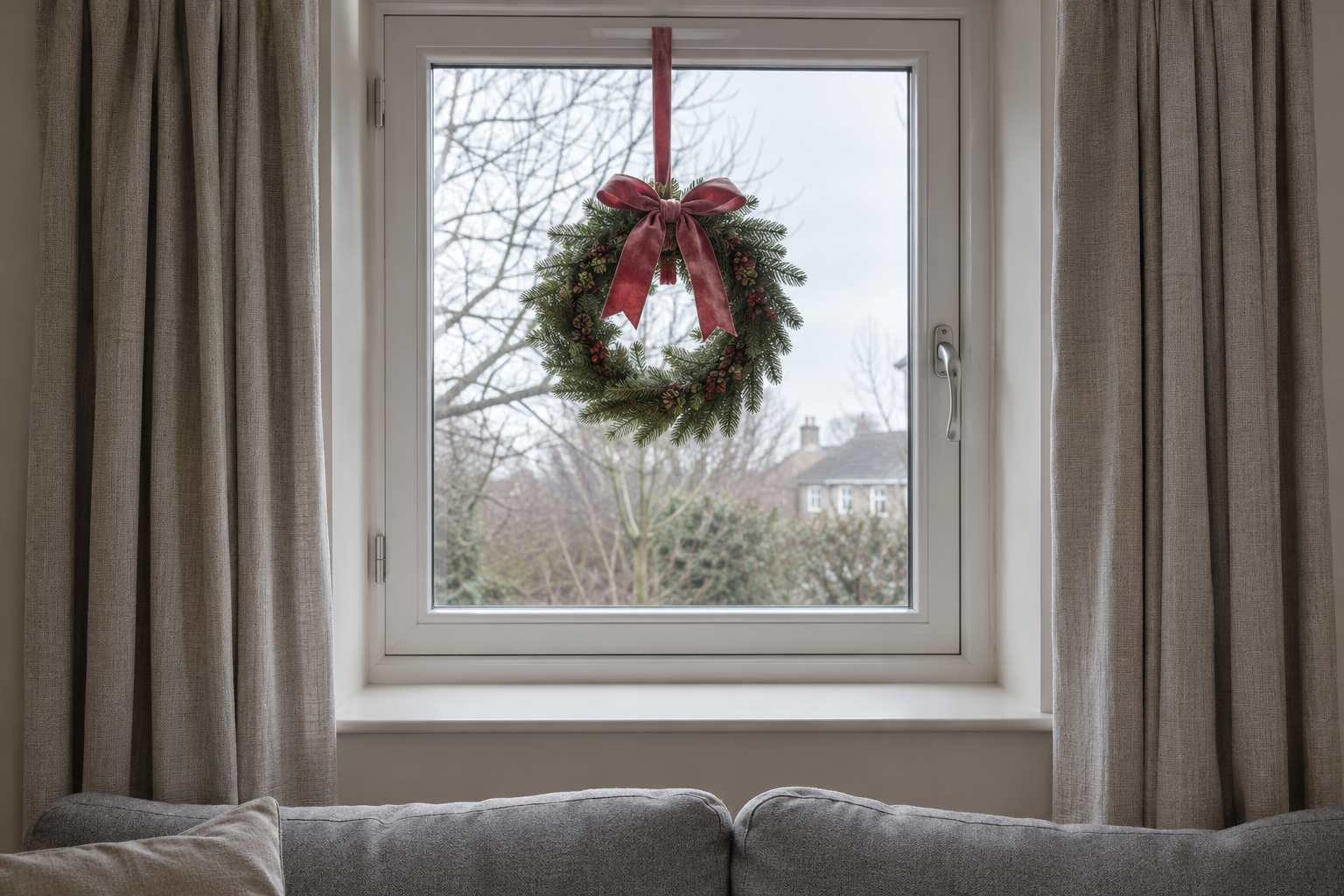
A flat arrangement of Christmas cards or a wreath can provide a focal point without another stand on the floor. Choose fixings for the wall finish and the decoration's weight. Removable adhesive does not guarantee damage-free removal, especially on wallpaper or fresh paint. Check your rental conditions before attaching anything.
For coffee table Christmas decor ideas, start with a tray that you can lift away in one movement. Use a few ornaments or a flameless candle, then leave enough clear surface for the things the table normally holds. If the tray must go on a seat whenever someone puts down a cup, it is too large for that table.
Your rug, curtains, or a favorite ornament can set the palette. A green room does not require more green everywhere: a few red ribbons may be enough to make it seasonal. Keep treasured mismatched ornaments if you love them. Repeating one ribbon or wrapping-paper color can connect them without replacing the collection.
Remove some everyday objects and give one shelf a small Christmas arrangement. Keep books and storage boxes you still need within reach. Avoid hanging loose garlands over a TV, speaker vents, or working lamps. A shelf display should not turn normal equipment into something you cannot safely use until January.
A small tree on an existing sturdy cabinet can give you the familiar shape without removing a chair. Check the cabinet top's depth, stability, and usable load, as well as the tree stand. Keep it out of a place where children or pets can pull it down. A narrow floating shelf is not automatically a suitable support.
You do not need to buy a decorative mantel for December. Hang stockings from suitable fixings on an existing wall or console, away from heat and access routes. A wreath above a sideboard gives the display a center. Leave cabinet handles clear so people can still open the doors without removing the decorations.

Choose one area for the fairy lights or string lights rather than outlining every object. Keep the lamp you use for reading; festive lights do not need to replace practical lighting. Follow the light set's instructions, check it for damage, and turn it off before bed or leaving home. London Fire Brigade recommends LED tree lights over older incandescent bulbs and warns against overloading sockets.
A large skirt and a ring of gifts can undo the space saved by a narrow tree. Keep gifts elsewhere until needed if the base is beside a walking route. In a living-dining room, leave room for a guest to pull out a chair. You should not have to dismantle the Christmas display to sit down together.
These are starting points, not rules about which colors make a room larger. Look at a proposed palette beside your sofa and flooring in daylight and with your evening lamps on. The same ornament can look quite different in those two conditions.
| Existing Room | Decorating Direction | Keep It Focused |
|---|---|---|
| Gray upholstery and light wood | Burgundy ribbon, cream textiles, brushed gold ornaments. | Repeat the ribbon on the tree and one other display. |
| Warm wood and cream upholstery | Deep green, warm-white lights, a few red accents. | Keep the existing wood visible instead of covering every surface. |
| Blue upholstery or a patterned rug | Silver or pewter ornaments with a color already in the fabric. | Use plain textiles where the existing pattern is busy. |
Use the palette on removable decorations first. You do not need to repaint a wall to make a Christmas scheme work. Choose a ribbon, ornament finish, or cushion cover that connects to what is already in the room, then decide whether anything else is needed.

Build the display around one existing surface and the wall above it. For example, a wreath above a cabinet, a compact tabletop tree, and a few red ornaments can read as a complete arrangement. Put the everyday decorative objects away first. Keep a section of the cabinet clear rather than filling its entire length.
If even a tabletop tree gets in the way, skip it. Use a wreath and a small tray of ornaments, with flameless candles if you want a glow. Repeating the same ribbon on the wreath and a cushion can connect the display across the room. This works in a rental flat without pretending there is space for extra furniture.
AI can help you judge a color scheme or a tree silhouette against your own room rather than a showroom. Paintit's photo-based living room design workflow uses your room image as the starting point. A generated concept is not a measured plan, a shopping list, or a safety assessment.
Start with this brief, replacing the details with your own:
Use my uploaded living room photo as the main image. Keep the existing gray sofa, wood floor, wall color, windows, and doors in their current positions. Explore Christmas decorations with a narrow tree in the back-left corner, red ribbons, cream cushion covers, and restrained warm-white lights. Leave the main route through the room visually open and keep the coffee table usable. Do not add a fireplace, move walls, or replace the furniture.
For a second version, ask for a tabletop tree on your existing cabinet and no floor-standing tree. Keep the rest of the brief the same so you can judge that specific choice. If you are new to working from a photo, the step-by-step room design guide explains how to separate the room image from a style reference.
Generated images can alter scale, furniture, and room details despite your instructions. Use the image to choose a direction, then return to the tape measure and the products' instructions.
Start with decorations that replace something already on display: cushion covers, a wreath in place of a picture, or a small arrangement on a cleared shelf. Choose a tree only after testing its footprint. Keep the surfaces and seats you use every day available.
Sometimes, but check the radiator or heater, curtains, window access, and route through the room first. A window is not a good position if it puts the tree too close to heat or blocks an escape route. Choose another position or a smaller display when those checks fail.
Unpack what you already own and pick one display area before shopping. Reuse cushion inserts, group existing ornaments, and repeat an inexpensive ribbon across the arrangement. A smaller tree can also reduce the amount of decoration you need, but compare actual prices rather than assuming it will always cost less.
Use a wreath as the main feature, add a compact display on a cabinet, and change one or two textiles. Leave blank space around the display so it remains visible. A room does not need a tree silhouette in every corner to feel ready for Christmas.
No. A photo-based image can help you compare appearances, but it cannot confirm a product's dimensions or clearances. Check tree width, stand size, height, access, heat sources, and manufacturer instructions in the real room. If the image makes the corner larger, discard that version.